
Buy Guide
Full Over Full Bunk Bed with Ladder: The Complete Guide for Families in 2026
Jun
Full Over Full Bunk Bed with Ladder: The Complete Guide for Families in 2026
When siblings share a room or you need extra sleeping space for guests, a full-over-full bunk bed with ladder is one of the smartest investments you can make. Unlike twin-over-twin bunks that feel cramped for older kids and adults, the full-over-full configuration gives both sleepers a spacious 54-inch by 75-inch mattress — the same surface area as a standard double bed.
This guide covers everything you need to know about full-over-full bunk beds with ladders, from dimensions and weight limits to materials, safety features, and how to choose the right one.
What Is a Full Over Full Bunk Bed with Ladder?
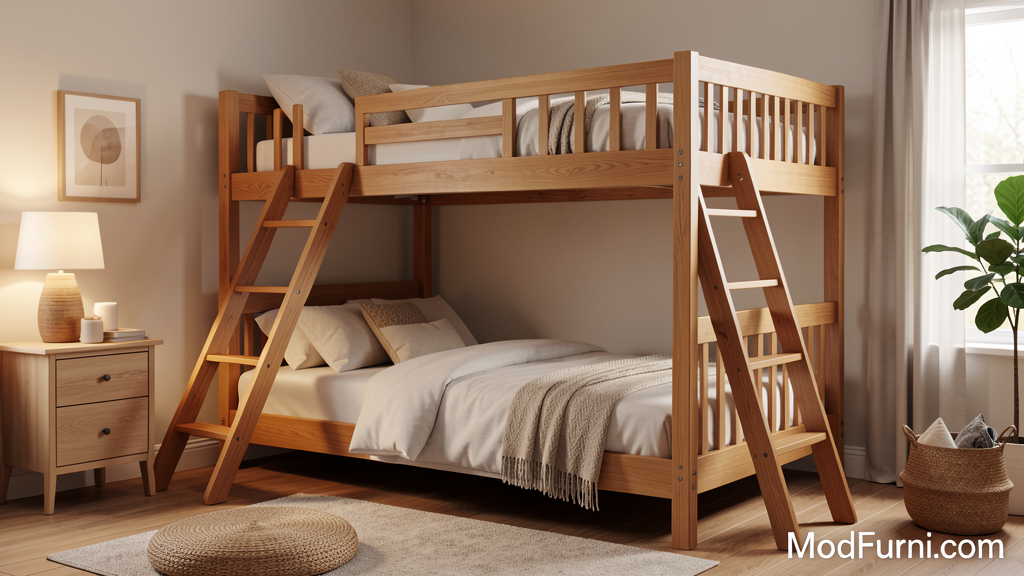
A full-over-full bunk bed with ladder stacks two full-size (double) mattresses vertically. Each mattress measures 54 inches wide by 75 inches long. That is significantly roomier than the twin-size bunks (39 by 75 inches) you see everywhere.
The ladder gets you to the top bunk, and you can usually mount it on the left or right side depending on how your room is laid out. Most full-over-full bunk beds include guardrails on the top bunk for safety. Some models add extras like built-in storage drawers or a trundle underneath.
Key dimensions to know:
- Mattress size (each level): 54″ W x 75″ L (standard full/double)
- Overall frame width: Typically 58–60 inches
- Overall frame height: Typically 62–70 inches
- Overall frame depth: Typically 78–82 inches
- Guardrail height (top bunk): 14–16 inches (meets federal safety standards)
- Ladder width: 12–18 inches
Who Needs One?
Full-over-full bunk beds solve a specific space problem. They work best for:
- Two teenagers sharing a room. Teens need the extra width a twin can’t provide. A full-over-full gives each teen real comfort without eating up floor space.
- Adults in a guest room. If your guest room doubles as a kid’s room, full-over-full bunks let two adults sleep comfortably without the room feeling like it has two separate beds stuffed into it.
- Siblings with an age gap. An older kid (10+) and a younger child can both sleep well here, since the bigger mattress accommodates growing bodies.
- College dorms and vacation homes. The vertical design saves space, and the full-size mattresses mean everyone gets a proper night’s rest.
- Families that host a lot. The bottom bunk doubles as a hangout during the day. A wider surface is way more comfortable for lounging.
Full vs Twin: Which Size Is Right for You?
The biggest question shoppers face is full-over-full or twin-over-twin. Here is how they stack up:
| Feature | Full Over Full | Twin Over Twin |
|---|---|---|
| Mattress width | 54 inches | 39 inches |
| Mattress length | 75 inches | 75 inches |
| Best for | Teens, adults, guests | Young children |
| Typical top weight capacity | 200–300 lbs | 150–200 lbs |
| Typical bottom weight capacity | 300–400 lbs | 200–250 lbs |
| Average frame width | 58–60 inches | 42–45 inches |
| Average frame height | 62–70 inches | 56–64 inches |
| Price range | $350–$900 | $200–$500 |
If you are buying for kids under 10, a twin-over-twin is usually enough and costs less. But if there is any chance teenagers or adults will use the bunks, spend the extra money now. You will not regret it.
What to Look for When Buying
1. Weight Capacity
Check the weight limit for both the top and bottom bunks. Good full-over-full bunk beds from solid brands support 200–300 pounds on top and 300–400 pounds on the bottom. A decent unit should handle 500–700 pounds total.
2. Ladder Design
The ladder comes in three styles:
- Straight vertical ladder. The most common type. It attaches to the side and takes up minimal floor space. Best for older kids and teens who are comfortable climbing.
- Angled or inclined ladder. Easier to climb because the angle is more gradual. Safer for younger kids but needs more floor space in front of the bed.
- Staircase-style ladder. Built like actual stairs with wider steps. The safest and most comfortable option, but it takes up the most room. Usually found on higher-end wooden bunks.
3. Material Options
Metal bunk beds use heavy-gauge steel tubing. They are lightweight, budget-friendly, and easy to move. Look for powder-coated finishes that resist chipping. Expect to pay $300 to $600.
Wood bunk beds use solid pine, rubberwood, or engineered wood. They look warmer and blend into a bedroom more naturally. Wood bunks are generally sturdier but heavier. Budget $400 to $900.
Solid hardwood bunk beds are the premium pick. Made from oak, maple, or birch, these are extremely durable and often come with features like built-in drawers. Prices range from $700 to $1,500.
4. Safety Features
Federal safety standards require guardrails on both sides of the top bunk. Look for:
- Guardrails at least 14 inches above the mattress surface
- Rail spacing no wider than 3.5 inches
- A sturdy ladder attachment with no sharp edges
- Lead-free, non-toxic finishes
- Meets ASTM F1427 or CPSC safety standards
5. Assembly
Full-over-full bunk beds come in knock-down packaging and require assembly. Most brands include clear instructions and all necessary hardware. Budget 1–3 hours with two people. A few things to check before buying:
- Does the bed use slats or need a box spring? Slat systems are more common and eliminate the need for an extra box spring.
- Are the slats evenly spaced? They should be no more than 3 inches apart to support mattresses properly.
- Are all tools included? Many brands ship with an Allen wrench or hex key.
Top 3 Picks for 2026
1. Heavy-Duty Metal Full Over Full Bunk Bed
Built from 14-gauge steel tubing, this bed supports up to 300 pounds on the top bunk and 400 on the bottom. The straight ladder mounts on either side, and the powder-coated black finish resists scratches. It uses a slat system so no box spring is needed. A solid budget pick for teens and guest rooms.
Check current price on Amazon:
Heavy-Duty Metal Full Over Full Bunk Bed |
Solid Wood Full Over Full Bunk Bed with Angled Ladder |
Full Over Full Bunk Bed with Storage Drawers
Best for: Shoppers who want durability without paying for wood.
2. Solid Wood Full Over Full Bunk Bed with Angled Ladder
This pine wood bunk bed uses an angled ladder that makes climbing safer for kids and adults. The solid wood construction is stable, and the natural finish blends with most decor. Guardrails extend 16 inches above the mattress. Expect assembly to take about 90 minutes with two people.
Best for: Families who prefer the look of wood and want a safer ladder angle.
3. Full Over Full Bunk Bed with Storage Drawers
Two built-in storage drawers slide out from under the bottom bunk, giving you space for bedding, clothes, or toys. The bed uses a mix of solid pine and engineered wood with a durable finish. It includes a vertical ladder and a trundle-ready base. The drawers add real value for small bedrooms.
Best for: Small bedrooms where every inch of storage matters.
Safety Rules Worth Following
Safety should always come first with any bunk bed. Here are the essentials:
- Top bunk is for ages 6 and up. The CPSC recommends kids under 6 should not sleep on the top bunk due to fall risk.
- Never remove the guardrails. Even for older kids, guardrails reduce the risk of rolling out during sleep.
- Use the right mattress thickness. The top mattress should not exceed 8 inches so the guardrail stays effective.
- Check the ladder regularly. Tighten bolts and screws every 3–6 months. Bunk beds loosen over time.
- No jumping or rough play. This one cannot be overstated. Bunk beds are for sleeping.
- Keep the bed away from ceiling fans and lights. The top bunk occupant needs clearance to sit up safely.
Frequently Asked Questions
Can adults sleep in a full-over-full bunk bed?
Yes. Full-over-full bunk beds with a weight capacity of 250 pounds or more per bunk work for adults. The full-size mattress (54 inches wide) gives most adults enough space. Taller people over 6 feet 2 inches might find the 75-inch length a bit short on the top bunk.
Do they require special mattresses?
No, standard full-size mattresses work. But most bunk beds use a slat foundation, so you do not need a box spring — just a standard full mattress on each level.
How tall are they?
Most full-over-full bunk beds measure 62 to 70 inches tall (5 feet 2 inches to 5 feet 10 inches). Check your ceiling height before buying. You need at least 30 inches of clearance between the top mattress and the ceiling for safe sitting.
Can I separate them into two beds?
Some models are designed to separate into two individual full-size bed frames. This is a useful feature if you want the flexibility to convert it later. Look for “convertible” or “separates into two beds” in the product description.
What is the weight capacity?
Quality full-over-full bunk beds support 200 to 300 pounds on the top bunk and 300 to 500 pounds on the bottom. Combined capacity is usually 500 to 700 pounds. Check the manufacturer’s specs before buying.
Final Thoughts
A full-over-full bunk bed with ladder solves a real problem. It gives you two full-size beds in the footprint of one. Unlike twin bunks that become useless as kids hit their teens, the full-size mattress on each level works for years.
Whether you go with metal for the price, wood for the look, or a model with storage drawers for extra utility, the full-over-full configuration is one of the smartest choices for families who need two beds in one spot.
Ready to find the right full-over-full bunk bed? Browse our collection of full-over-full bunk beds with ladders, or check out our guides on loft beds with drawers and twin loft beds for more space-saving ideas.