
Buy Guide
Split Queen Adjustable Bed with Mattress: Size and Fit Guide

Nov
Split Queen Adjustable Bed with Mattress: Size and Fit Guide
Definition: A split queen adjustable bed with mattress is a queen-size sleep system built from two independently moving halves, each about 30 by 80 inches, so each sleeper can raise the head and foot sections without moving the other side.
A split queen adjustable bed with mattress is the compromise couples ask for when a split king is too wide for the room but one shared mattress has stopped working. It is also the least standardized adjustable setup sold in the US: the halves are narrower than a twin, the sheets are a specialty item, and the frame you already own may or may not accept the base. This guide covers the measurements that decide fit, what to look for in the mattress, and the five mistakes that send these systems back to the retailer.
What a split queen actually is
A split queen is not one queen mattress with a hinge. It is two separate mattress-and-base units placed side by side. The combined footprint equals a standard queen, but each half is its own articulating platform with its own motor, remote, and mattress.
That distinction drives every other buying decision. Because the halves are independent, they can be set to different head and foot angles, and a tall sleeper’s raised head does not lift the other person’s side. The trade-off is practical: a standard queen mattress will not work on this setup, and bedding cut for a 60-inch-wide queen will not stay fitted on a 30-inch half.
Quotable: A split queen adjustable bed uses two mattresses of roughly 30 by 80 inches each, giving the same 60 by 80 inch footprint as a standard queen while allowing each side to adjust independently. (Source: Sleep Foundation split queen sizing guidance; manufacturer listings reviewed for this guide.)
Packages are usually sold this way: a Split Queen Adjustable Bed Frame with Mattress Set pairs two 30 by 80 inch halves and ships in two separate cartons, because a steel base and two mattresses do not travel in one box.
The measurements that decide fit
Start with the footprint, then work outward. The numbers below are the ones that cause the most returns when they are skipped.
| Measurement | Inches | Metric | Why it matters |
|---|---|---|---|
| Combined footprint | 60 x 80 | 152.4 x 203.2 cm | Same floor space as a standard queen |
| Each mattress and base half | 30 x 80 | 76.2 x 203.2 cm | You need two; one queen mattress will not substitute |
| Clear space inside a bed frame | At least 60 x 80 | 152.4 x 203.2 cm | Interior rails, a center support, or a footboard lip can block the base |
| Half-mattress width for bedding | 30 | 76.2 cm | Standard twin sheets are wider and will not stay tucked |
Two practical notes on that table. First, 60 by 80 inches is a starting point for the frame interior, not a guarantee: manufacturers quote slightly different outside dimensions, and a base with a wider steel perimeter needs more room than the mattress it carries. Second, measure the frame you plan to reuse before you order the base, not after. A queen frame with a low footboard rail or a fixed center slat is the single most common reason a split queen base will not drop in.
Mattress choice: flexibility beats thickness
The mattress has to bend where the base bends. A firm innerspring built for a flat foundation will resist the articulation, ride up at the hinge line, and in some cases void its own warranty once it is used on an adjustable base.
One documented split queen bundle pairs two 11-inch hybrid mattresses with the base. According to the seller’s product page, each mattress uses 2 inches of gel memory foam over high-density comfort foam and pocketed coils, and the same page states that the mattresses are designed to flex on an adjustable base. At the other end of the market, half mattresses sold on their own include a 7-inch medium-firm memory foam split queen half mattress at 30 by 80 inches and about 45 pounds. (Sources: Beverly Hills Bed split queen hybrid bundle listing; Amazon half-mattress product page.)
Quotable: Foam, latex, and flexible hybrid mattresses track an adjustable base; a stiff mattress that resists bending can ride up at the hinge and may fall outside its warranty for adjustable-base use. (Source: Sleep Foundation and Consumer Reports adjustable bed guidance.)
Whatever you shortlist, check two things in writing: the manufacturer’s adjustable-base statement and the warranty language that covers it. Mattress sets sold in the US must also meet 16 CFR Part 1633, the federal open-flame flammability standard for mattress sets enforced by the CPSC, so a legitimate listing will carry the required labeling.
Weight limits: read the fine print
Published capacities for split queen bases vary, and the number alone does not tell you what it covers. The Brick’s product page for its Quest 2.3 split queen adjustable base states a 750 pound capacity, while Beverly Hills Bed states 850 pounds for one of its split queen bases. Neither listing makes clear whether the figure applies to each half or to the combined system, or whether it includes the mattresses and the sleepers.
Treat the rating as a question, not a spec. Ask the seller whether it is per side or combined, and whether mattress weight counts against it. On our own queen adjustable base, the published capacity is 750 pounds across a 79 by 59 by 12.72 inch steel and wood frame with a head range of 0 to 61 degrees, a foot range of 0 to 37 degrees, and a motor rated at 50 dB or less. That is a one-piece queen base, not a split unit, and the numbers show the pattern: capacities in this category cluster around 750 pounds, and what varies is how the seller defines it.
Quotable: Split queen base capacities are commonly listed between 750 and 850 pounds, but listings frequently do not state whether that figure applies per half or to the whole system including mattresses. (Source: The Brick Quest 2.3 and Beverly Hills Bed split queen base listings.)
Will it fit the bed frame you already own?
Sometimes. The base has to sit inside the frame’s clear interior with nothing pressing on the deck, and the frame has to be open at the foot so the foot section can rise. Three measurements settle it:
- Interior width and length. You need at least 60 by 80 inches of clear space between the rails. A queen frame nominally sized for a 60 by 80 mattress often measures less once the rails and upholstery are counted.
- Center support. A frame with a fixed center rail or a center leg runs straight down the line where the two halves meet. That rail will foul the base’s frame and prevent independent movement.
- Footboard height and lip. Any footboard taller than the base’s retainer bar will stop the foot section from rising. Low-profile and open-foot designs avoid the problem entirely.
If you are buying new, the simplest path is a frame sold with the base rather than around it. Our adjustable bed base collection lists the frame and base as one unit, including the adjustable queen bed base frame and the queen bed frame with head and foot incline, which adds bedside USB ports and under-bed lighting. If you want a fixed frame with an adjustable base inside it, a slatted platform bed frame with an open foot is the configuration to compare against the three checks above.
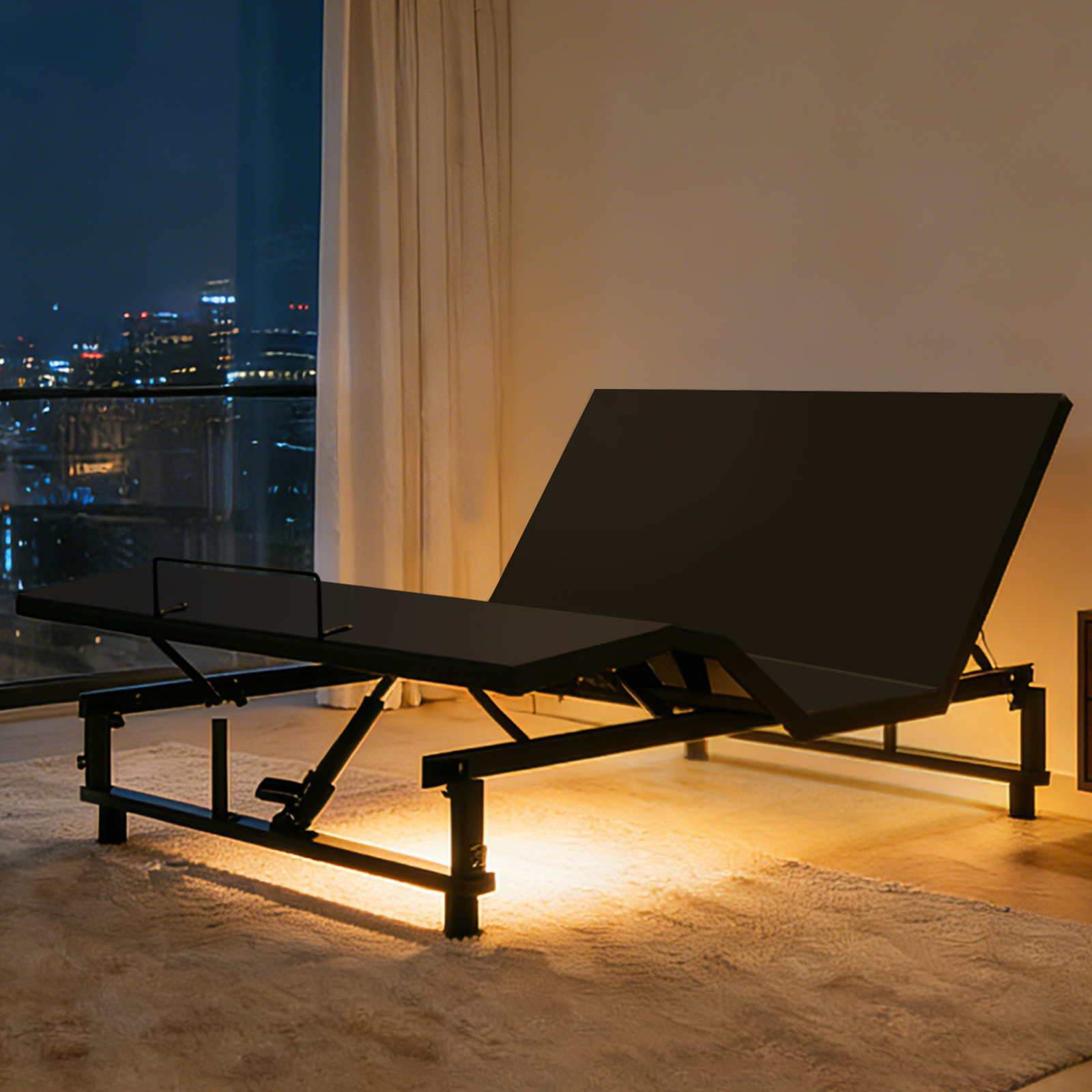

Headboard clearance deserves its own check, because the head section swings up and back. The fit rules for a panel mounted behind an articulating base are covered in our guide to a king size headboard for an adjustable bed, and they apply unchanged to a queen-width panel.
Bedding: the 30-inch half problem
Split queen halves are narrower than a standard twin mattress, so ordinary twin sheets will not fit them. The Sleep Foundation makes the point directly in its split queen guidance: at 30 by 80 inches, each mattress is an unusual size, and regular twin sheets are the wrong shape. Queen fitted sheets are worse, since they are built to span the full 60-inch width and will pull loose the moment one side elevates.
What works is bedding cut for the exact half dimensions with a deep enough pocket for the mattress height. A two-piece split queen sheet set sized 30 by 80 inches with a 16-inch deep pocket is the direct match, and it shows the format to look for: two fitted pieces, not one wide sheet.
Layer the same way you would on any adjustable bed: a fitted sheet that grips the half, a flat sheet and blanket that can move with the head section, and nothing tucked under the mattress edge at the hinge line. Anything tucked tight across the split will bridge the two halves and defeat the independent movement you paid for.
Five mistakes that send split queens back
- Buying one standard queen mattress. A single 60 by 80 mattress cannot flex independently over a split base, so the two sides stop working as two sides.
- Assuming twin or queen sheets will do. Neither fits a 30-inch half properly, and the fitted sheet will pop off as soon as the head rises.
- Choosing a mattress that fights the base. A stiff mattress that resists bending rides up at the hinge and may lose warranty coverage for adjustable-base use.
- Reusing a frame with a center rail or tall footboard. Both block the base’s range of motion, and neither is fixable without modifying the frame.
- Trusting a weight rating without asking what it covers. A 750-pound figure means very different things per half and for the whole system with two sleepers and two mattresses on it.
One more habit worth keeping: confirm the retail packaging and delivery route before you order. Split queen systems ship as multiple cartons, and some sellers split the shipment across two deliveries, so a single tracking number is not proof that the whole order arrived. Check the carton count against the packing list before you assemble anything, and photograph the boxes if a piece is missing.
Queen frames and bases that suit this setup
These collections are grouped the way buyers actually narrow down this choice, so the specs you need are one click apart.
Frequently asked questions
How wide is each half of a split queen mattress?
Each half is typically 30 inches wide by 80 inches long, or about 76.2 by 203.2 centimeters. Two halves side by side produce the same 60 by 80 inch footprint as a standard queen mattress, but they move independently.
Can I put a regular queen mattress on a split queen adjustable base?
No. A single 60 by 80 inch mattress spans both halves and cannot flex independently over them, which cancels the reason to buy a split base. Split queen systems require two mattresses sized for the individual halves.
Do I need special sheets for a split queen adjustable bed?
Yes. Standard twin sheets are too wide for a 30-inch half and standard queen sheets span both halves, so neither stays in place when one side elevates. Look for split queen sets cut as two 30 by 80 inch pieces with a deep pocket.
What weight can a split queen adjustable bed hold?
Published capacities vary by model, with documented examples at 750 and 850 pounds. Ask the seller whether the number applies per half or to the combined system, and whether it includes the mattresses and the sleepers, because the listings often do not say.
Will a split queen adjustable bed fit inside a standard queen bed frame?
Only if the frame leaves at least 60 by 80 inches of clear interior space with no center support rail and no footboard lip above the base’s retainer bar. Measure the frame interior and the base’s outside dimensions before ordering, since models differ slightly.
The short version
A split queen adjustable bed with mattress works when three things line up: two correctly sized 30 by 80 inch mattresses that are approved for adjustable use, a base whose weight rating you have confirmed in writing, and a frame that leaves the base enough clear interior to move. Get those right and the format delivers what a shared queen cannot, which is two independent sleeping positions in the floor space of one bed.
If you are still deciding between a base-only purchase and a complete frame, compare the models in our adjustable bed base collection against the measurements above, and read our breakdown of mattress foundation versus box spring before you add any support layer under the base.