
Buy Guide
Platform Bed Frame for Memory Foam: Slat Spacing Guide
Oct
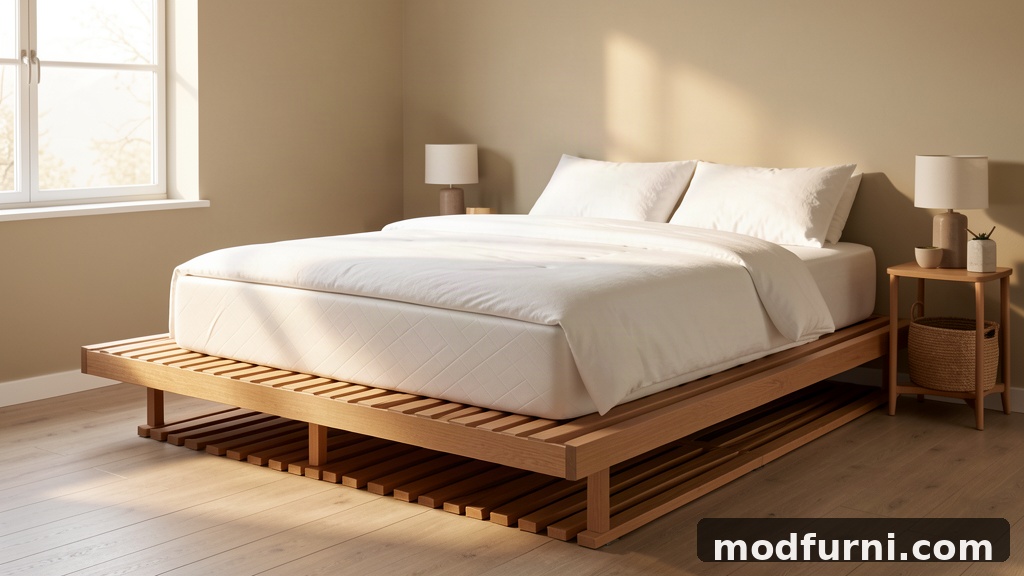
Platform Bed Frame for Memory Foam Mattress: Slat Spacing and Support Rules
Definition: A platform bed frame for a memory foam mattress is a bed base that holds the foam directly on a slat or solid deck with no box spring, and its fit depends on four specs: slat spacing, center support, deck flatness, and rated weight capacity.
Buying a platform bed frame for a memory foam mattress looks simple until you read the listings closely. Two frames that both say “no box spring needed” can space their slats 2.5 inches apart or 4.8 inches apart, and that gap decides whether your foam sleeps flat or slowly sinks between the boards. Foam has no coils to bridge a gap, so the support surface does the work a spring unit normally does.
This guide covers the numbers that matter – slat spacing, center support, capacity definitions, and clearance – using published specifications from current listings and the two standards that govern bed-base testing. Every figure below is attributed. Where a listing does not state a number, we say so instead of guessing.
What a memory foam mattress needs from a frame
Memory foam distributes load across its whole surface, which is why a gap under the mattress becomes a dip over time. Three requirements follow from that:
- Continuous support. Slats spaced no more than 3 inches apart, or a solid deck, so the foam cannot sag between boards.
- Center support on larger sizes. A center rail plus at least one leg reaching the floor, so the middle of a queen or king does not bow.
- A flat, level deck. A frame that flexes or rocks gives the mattress an uneven base no matter how good the foam is.
Quotable: Slat spacing of 3 inches or less is the common rule for foam mattresses, and reviewer guidance from Tom’s Guide sets the ceiling even lower, at two and three-quarter inches; some mattress makers publish stricter limits, and the mattress warranty takes precedence over any general rule.
That last clause is the one buyers skip. A frame can be well built and still void a mattress warranty if the manufacturer requires closer spacing or a solid foundation. Check both documents before the frame ships, not after the mattress sags.
Slat spacing in the wild: what published listings actually say
Retail listings rarely put slat spacing in the headline specs, which is why it is worth measuring before you buy. The table below shows figures taken from current published listings, so you can see how wide the real range is.
| Frame or product listing | Support surface | Stated capacity | Source |
|---|---|---|---|
| AFI Madison solid wood, queen | Rubberwood frame; slats about 2.5 in wide, 3.5 in apart | 800 lb | Home Depot listing |
| AMERLIFE solid pine, full | Wood slats 4.8 in apart; center beam | 1,300 lb | Target listing |
| Plank+Beam solid pine, full | Plywood slats plus metal support bar; listing says memory foam compatible | 500 lb resting capacity | Target listing |
| Douglas platform frame | Slat deck; 4.5 in under-bed clearance listed | 350 lb twin and twin XL; 700 lb full, queen and king (350 lb per side) | Douglas listing |
| Mixed rubberwood, MDF and plywood platform | Wood platform, no box spring required | 500 lb queen; 600 lb king | Overstock listing |
Two things stand out. First, the 4.8-inch gap on the AMERLIFE frame exceeds the 3-inch foam rule even though the frame is rated to 1,300 pounds – capacity and slat spacing measure different things. Second, capacity figures are not written to a common standard, so an 800-pound rating and a 500-pound rating may not be measuring the same load.
Quotable: A high weight rating does not certify slat spacing: the AMERLIFE full-size platform bed is listed at 1,300 lb with wood slats 4.8 inches apart, which is wider than the 3-inch foam guidance even though the frame is strong.
Do you need a box spring under memory foam?
No. A platform frame exists to replace the box spring, and on foam the box spring is usually the weaker choice. Tom’s Guide warns that spring bases can support a mattress on spacing that is too wide, and Sleep Sage recommends a firm, level deck rather than a flexing base.
The practical rule: foam wants a flat, dense surface. A box spring adds springs between you and the frame, which reintroduces the bounce and point-loading that foam is designed to avoid. If you already own a box spring and want the extra height, a slatted platform plus a thin bunkie board is a more predictable stack than platform plus box spring. Our comparison of mattress foundations versus box springs covers the height and cost trade-offs in more detail.
Center support and weight limits: read the wording
On a queen or king, the middle of the frame carries load far from any leg. Sleep Sage advises checking for a center support on queen-size and larger frames, plus a level deck. Without it, the center rail sags and the mattress follows, which shows up first as a body impression down the middle of the bed.
Weight limits need the same care. Some listings rate the frame, some rate the frame plus mattress, and some rate per side – the Douglas listing, for example, gives 350 pounds for a twin and 700 pounds for a queen, described as 350 pounds per side. Count your mattress weight and two sleepers against whichever definition the listing uses.
Quotable: ISO 19833:2018 sets test methods for bed-base stability, strength and durability – including vertical durability of the base and horizontal durability of the frame – but it is a test-method standard, not a universal load rating, so a stated capacity is a manufacturer figure rather than a certified test result.
Europe has a comparable framework in EN 1725:2024, which covers fully assembled adult beds and components, with tests based on users weighing up to 110 kg (about 242 lb). Neither standard is a promise that a specific bed was tested to it; look for an explicit standard-and-test claim in the product documentation if that assurance matters to you.
Ventilation and heat: the trade-off between slats and a solid deck
Memory foam can sleep warm because it hugs the body and restricts airflow at the contact surface. A slatted deck lets air move under the mattress; a solid panel blocks it. That is the honest trade-off, and it cuts against the usual “solid is always better” advice.
A solid deck gives even support and no gaps. Slats give airflow and lighter weight. If you choose a solid panel for a warm sleeper, look for a breathable foundation or drill nothing yourself – modifying a deck usually voids the frame warranty. A breathable bunkie board over wide slats is the middle path: it closes the gaps without sealing the underside completely.
Matching frame material to a foam mattress
Material tells you how the frame handles load and noise, not whether it suits foam. What matters is the deck and the support geometry.
- Wood and engineered wood: broad slat surfaces, quiet, and the most common choice for upholstered platforms. Panel thickness and joinery decide how it ages.
- Metal with steel slats: thin, strong, and usually the least expensive way to get a low-profile deck, but check the slat spacing because steel slats are often spaced for spring mattresses.
- Upholstered platforms: the deck and slats sit inside a fabric-wrapped frame; the padding changes nothing about support, but the frame depth usually grows, which matters in tight rooms.
Our platform bed collection splits along those lines. The queen platform bed frame uses a wood slat support system and needs no box spring; the full size metal platform bed frame runs steel slats in a metal structure for a lower profile. If storage matters more than a low deck, the queen storage platform bed frame pairs an upholstered headboard with side bookcases and a drawer. Ask us for the slat spacing on any specific frame before ordering if your mattress maker publishes a strict limit.



For comparison shopping across the two most common Amazon options in this category, the ZINUS Moiz wood platform bed frame is a slatted wood frame, and the ZINUS Vivek Deluxe platform bed frame with headboard adds a headboard to the same slat-and-rail approach. Both are wood-slat platforms rather than solid decks, so the slat-gap check applies to them exactly as it does here.
How to fix a frame whose slats are too far apart
If you already own the frame, the fix is cheap and does not require replacing the bed. Work in this order:
- Measure the gap, not the slat. Run a tape between two slats, inside edge to inside edge. Write down the widest gap you find.
- Check the mattress warranty wording. Look for required slat spacing, a maximum gap, or a foundation requirement.
- Add slats if the frame allows it. Cutting two or three boards to length and screwing them to the rails halves the effective gap for a few dollars.
- Or lay a bunkie board. A 10 mm board spreads load across the gaps; a breathable version keeps some airflow. The Noble Realm 10 mm bunkie board in queen size is the low-profile type that sits under a foam mattress without adding a spring unit.
- Confirm the center support reaches the floor. If the center leg hovers, shim it; a floating center rail does nothing.
Owner reports back up the difference this makes. One mattress-forum poster described replacing a 3.5-inch-gap frame with one at 2.5-inch spacing after the foam felt unsupported, which is the same correction in a different order.
Before you buy: a six-point check
- Mattress size, not frame label. U.S. mattresses run 38 x 75 in (twin), 38 x 80 in (twin XL), 54 x 75 in (full), 60 x 80 in (queen) and 76 x 80 in (king). Compare those to the frame’s stated mattress-fit dimensions, not its overall footprint.
- Slat gap. 3 inches or less, tighter if your mattress maker says so.
- Center support. Required in practice on queen and king, with a leg that touches the floor.
- Capacity definition. Frame only, frame plus mattress, or per side?
- Under-bed clearance. The Douglas frame lists 4.5 inches, which fits low storage boxes but not a standard bin.
- Assembly and access. A platform bed is a knockdown product; check that the box fits your stairwell and that the rail bolts are accessible once assembled.
The platform bed frame for memory foam we stock, sorted by type
These collections are grouped the way buyers actually narrow down this choice, so the specs you need are one click apart.
Frequently asked questions
Does a memory foam mattress need a box spring on a platform bed?
No. A platform bed is designed to replace the box spring, and foam generally does better on a flat, dense deck than on a spring base. Tom’s Guide warns that spring bases can space their support too widely for foam, so a slatted or solid platform is the simpler choice.
How far apart should slats be for a memory foam mattress?
Three inches or less is the common rule, and Tom’s Guide sets the limit at two and three-quarter inches. Some mattress makers publish stricter limits in their warranty terms, and those terms override general guidance, so read both the frame spec and the mattress documentation.
Can I put memory foam on a metal platform bed with steel slats?
Yes, if the slats are closely spaced and the frame has center support in queen and king sizes. Steel slats are often spaced for spring mattresses, so measure the gap rather than assuming; adding slats or a thin bunkie board closes a gap that is too wide.
What if my platform frame has slats more than 3 inches apart?
Add two or three slats to the rails, or lay a low-profile bunkie board over the existing deck. Both spread the load across the gaps. Check the mattress warranty first, and confirm the center leg reaches the floor so the middle of the frame is not carrying load unsupported.
Does slat spacing affect a mattress warranty?
It can. Several mattress makers specify a maximum slat gap or require a solid foundation, and a claim can be refused when the frame does not meet it. The frame’s stated weight capacity is a separate figure and does not stand in for a support-surface requirement.
The short version
For memory foam, the frame’s job is continuous, flat, well-supported contact. Slat gaps of 3 inches or less, a center rail with a floor-touching leg on queen and king, and a capacity figure you have read the definition of will matter more than the finish, the headboard, or the brand.
Start with the gap measurement and the warranty wording, then choose the frame. If you want a low deck with wood slats, browse the platform bed frames at ModFurni, or compare the size-specific guides for queen platform bed dimensions and twin platform bed sizes before you commit to a footprint.