
Buy Guide
Bed Frame Compatible With an Adjustable Base: 2026 Fit Guide
Nov
Bed Frame Compatible With an Adjustable Base: The 2026 Fit Guide
Definition: A bed frame compatible with an adjustable base is a frame whose clear interior opening equals or exceeds the base’s outside footprint by whatever clearance the base maker requires, and which leaves no fixed slats, center rail, deck, or footboard in the path of the head and foot sections as they articulate.
Most shoppers assume a queen frame fits a queen adjustable base. It does not follow. The mattress size label describes the sleeping surface, not the hardware underneath, and a base is a machine with a perimeter frame, legs, motors, and a retainer bar that has to live inside your furniture. A bed frame compatible with an adjustable base is therefore something you verify with a tape measure, not with a size tag. This guide covers the three ways a base can sit in a frame, the four measurements that decide whether it fits, which frame styles work and which ones fight the mechanism, and how to read a weight rating that means what you think it means.
Three ways a base sits, and only one of them is “drop-in”
Compatibility questions go wrong at the start because “fitting a base in a frame” describes three different installations. They have different clearance needs, and a frame that works beautifully for one can be useless for the next.
1. The base keeps its legs and stands inside the frame
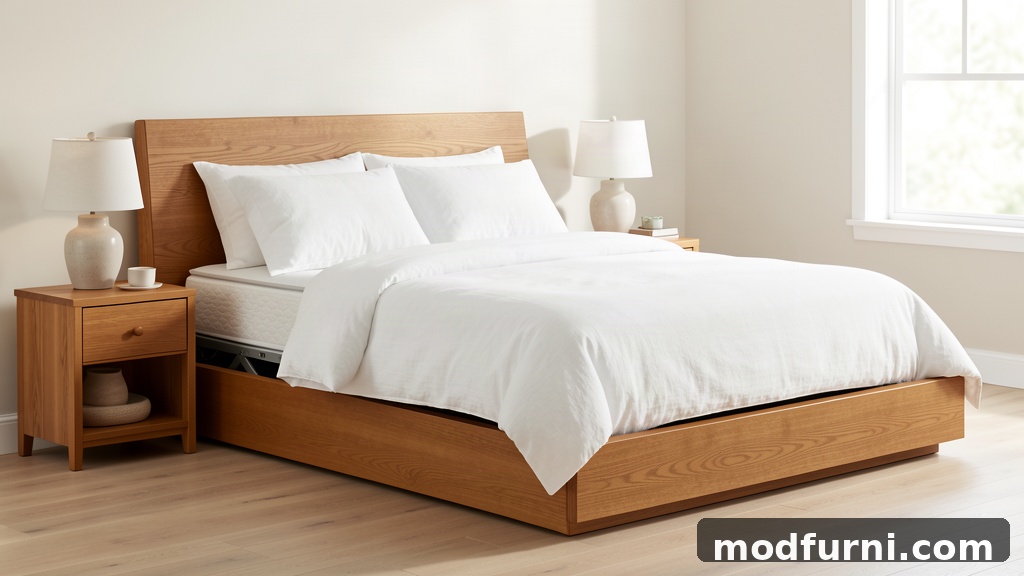
This is the common setup for an adjustable base bought to replace a box spring. The base stands on the floor on its own legs, the frame is a decorative surround, and the mattress rides on the base. Here the frame has to be wide enough inside to clear the base’s perimeter and tall enough for the frame rails to sit below the platform surface, and the head and foot sections need vertical room to rise. Nothing rests on the frame’s slats, so fixed slats are irrelevant – but the frame’s side rails and footboard are very much in the way if the base overhangs them.
2. The base drops in with its legs removed (zero-clearance)
A zero-clearance base is designed to sit on a platform or on the frame’s own support structure, with the legs off. This is the configuration that makes a decorative bed frame and an adjustable base work together, and it is also the one with the tightest measurement rules. The support surface has to be flat, rated for the load, and free of the frame’s own slats if the base manufacturer says the slats must come out. Sleep Number’s support documentation is explicit on this point: slats are removed before delivery for its base, and the frame’s cleat-to-cleat width is what determines whether the base drops in.
3. The base sits outside the frame entirely
In a headboard-only arrangement, the frame carries only a headboard panel and two short rails, and the base stands independent of it. Compatibility then reduces to one question: does the headboard sit far enough back that the raised head section does not collide with it. That is a geometry problem rather than a width problem, and it is covered in our guide to a king size headboard for an adjustable bed.
The four measurements that decide fit
Every fit failure traces back to one of these four numbers. Take them before you order, not after the cartons arrive.
| Check | What you measure | Reference figure from manufacturer guidance |
|---|---|---|
| Frame opening vs base footprint | Clear interior width and length between rails, cleats, or brackets – the narrowest point, not the widest | One brand specifies an opening 0.4 to 0.8 in (10 to 20 mm) larger than the base on every side; treat that as a brand rule, not a standard |
| Base outside dimensions | The exact model and size you are buying, from its own specification sheet | Published queen figures vary: 79.5 x 59.5 in from two major brands; a king at 79.5 x 75.5 in; a full-size base at 74.6 x 53.7 in |
| Interior ledge height | Height of the frame’s side ledge or cleat above the floor, if the base is meant to rest on it | One manufacturer requires at least 10.25 in of clearance for its ledge, with extended-height legs allowed only where the ledge is no more than 11.75 in off the floor |
| Movement path | Anything the head and foot sections would strike when fully raised – footboard lip, drawer fronts, a tall side rail | Judge the raised position, not the flat one; a base that fits flat can still be blocked once it articulates |
The first row is where most returns originate. Manufacturers publish outside dimensions for the base, shoppers compare that number to the mattress size printed on the frame’s spec sheet, and the two figures describe different things. A queen base listed at 79.5 by 59.5 inches is not the same object as a queen frame whose rails sit at a 60 by 80 inch nominal opening, because the rail thickness and any cleats reduce the usable space.
Quotable: A bed frame opening needs roughly half an inch to three-quarters of an inch of clearance beyond the base on every side (10 to 20 mm), according to SweetNight’s fitting guidance for its own base – a brand-specific rule rather than an industry standard, so measure against the instructions for the base you actually bought. (Source: SweetNight, “Can You Put an Adjustable Base in a Bed Frame?”)
Quotable: Sleep Number’s published mattress and base specifications list a queen adjustable base at 79-1/2 by 59-1/2 inches, and Tempur-Pedic publishes the same queen footprint, so the mattress size label alone cannot tell you whether a frame will accept a base. (Sources: Sleep Number support, “Mattress and Base Specifications”; Tempur-Pedic power base product specifications.)
Frame styles that work with an adjustable base
Open-rail metal frames
Steel frames with a headboard and two side rails, no deck, and no fixed cross-supports are the most forgiving host for a standing base, because there is simply less material to collide with. Metal is common in adjustable bases and open frames alike, and ratings attach to specific products: one steel adjustable base is listed at 650 lb maximum capacity, another metal model with steel slats at 620 lb. Those are model figures, not a material property – steel does not come with a load rating.
Platform frames with removable slats
A platform frame can host a zero-clearance base, but only if the slats come out and the remaining support structure is approved for the load. Slat spacing matters for a mattress directly on slats – we cover that in the platform bed slat spacing guide – and the same removable slats that make a platform frame good for a foam mattress are what make it adaptable to a base. Browse the full platform bed collection if you want a frame you can reconfigure later.
Upholstered frames built on an open deck
Upholstery is not the problem; a solid deck is. A fabric-wrapped frame with an open interior and a headboard accepts a standing base the same way a metal frame does, and it hides the mechanism, which is the reason most people want one. A published review of a mixed-material frame – upholstered steel rails, wooden slats, wood-veneer legs – lists a suggested 750 lb capacity, which illustrates the point that the rating belongs to the product, not the style.
Purpose-built adjustable frames
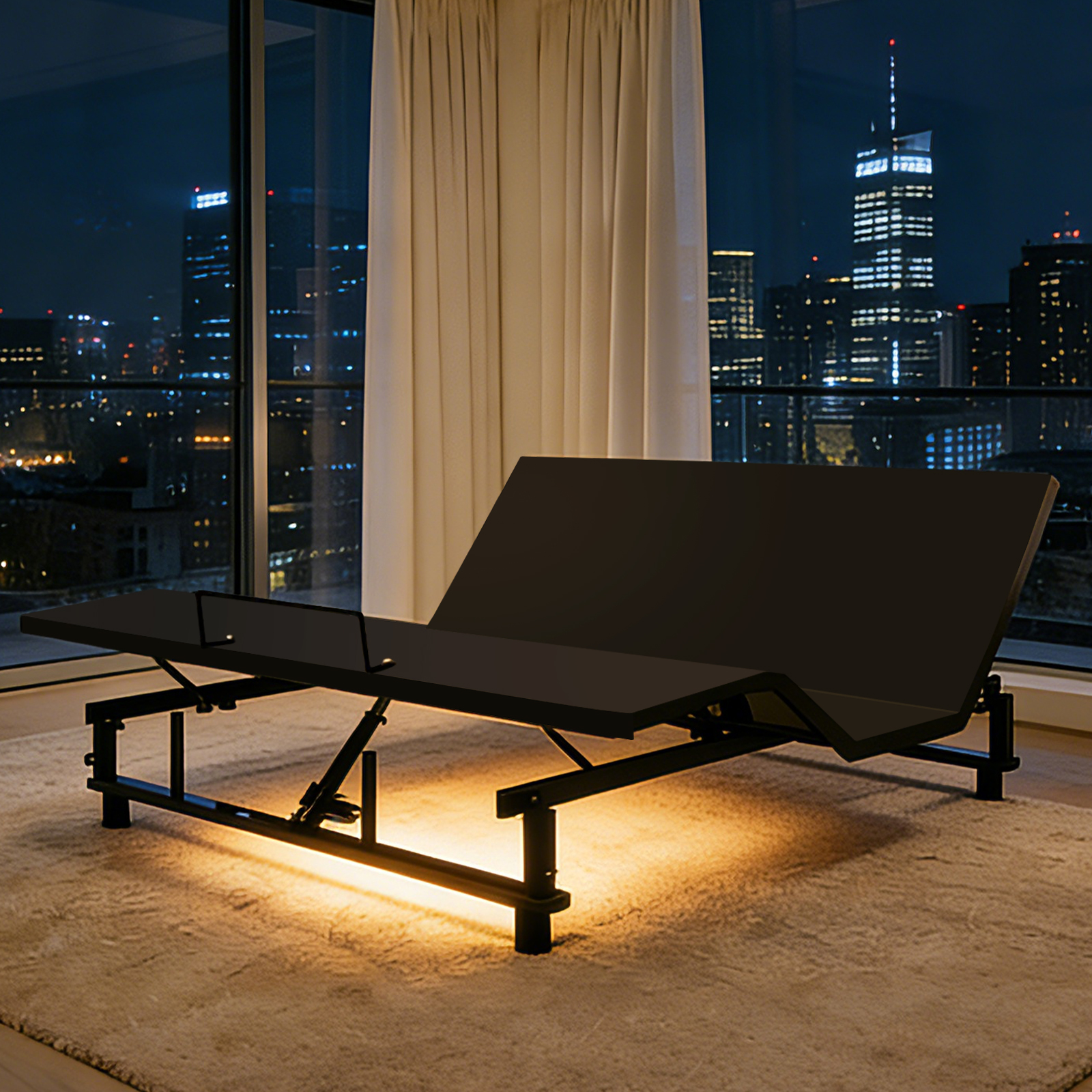
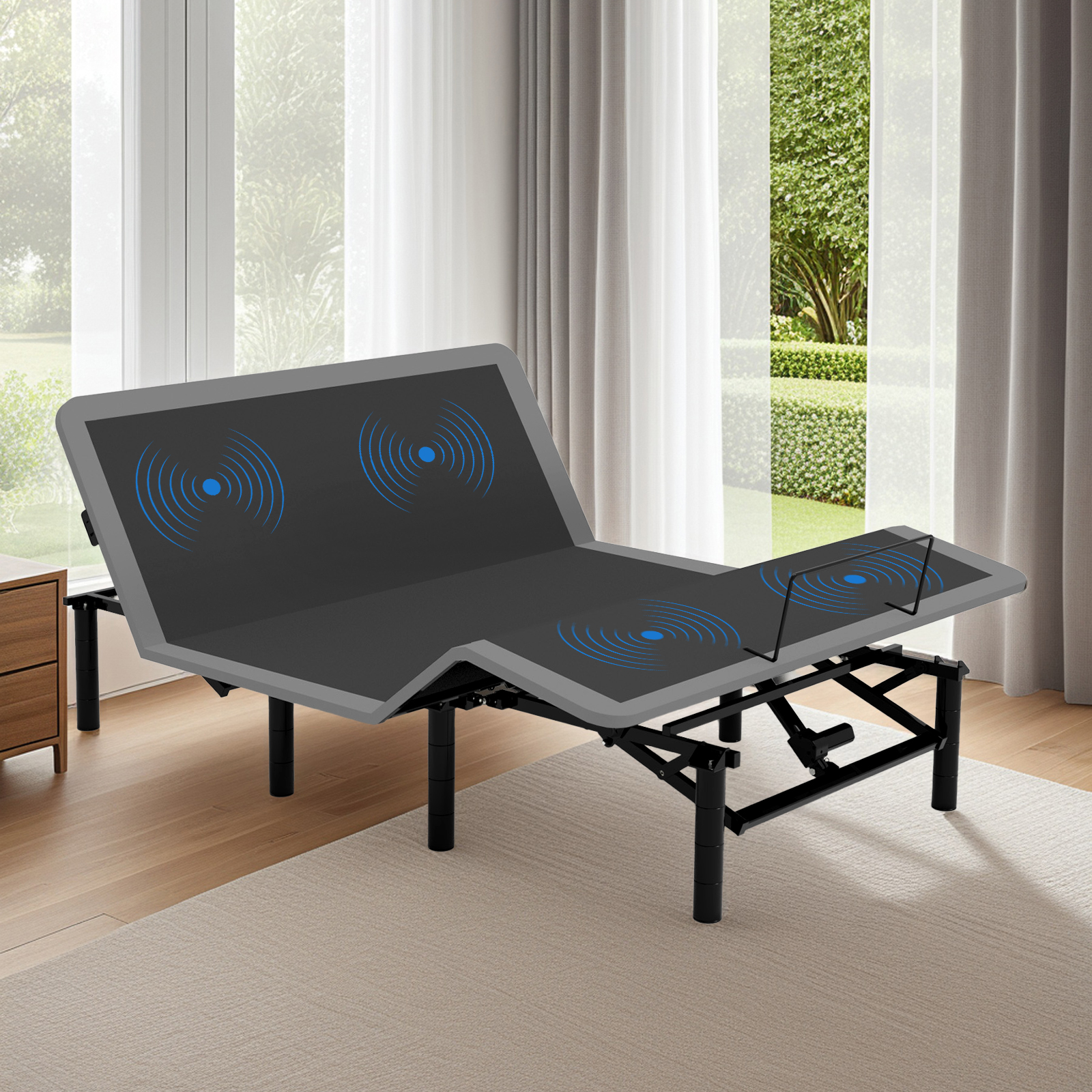
The fourth option skips the retrofit entirely: buy a frame sold with the mechanism, so the widths, ledges, and leg positions are already matched. Our adjustable bed base collection covers this category, including the Queen Size Adjustable Bed Frame and, for wider rooms, the King Bed Frame with Head and Foot Incline. If you already own a flat base and only the mattress is changing, read our mattress foundation versus box spring comparison first, because the support layer under the mattress changes the answer.
Frame features that fight the mechanism
- A fixed platform deck. A solid or fully slatted deck sits exactly where a drop-in base needs to be, and it cannot be lowered without cutting the frame.
- A center support rail. Common on queen and king frames, useful for a rigid foundation, and a hard stop for a base with a motor housing or retainer bar down the middle.
- A footboard with an inward lip. The foot section travels; the lip does not. A base that fits flat can jam against it at the top of its travel.
- Under-deck storage drawers. Drawer boxes occupy the depth the base needs for its legs, motors, and frame, and they are usually structural rather than removable.
Quotable: Slats, center rails, and crosspieces left in place are the most frequently cited cause of an adjustable base that will not seat correctly, and at least one major base maker instructs that slats be removed before delivery rather than trusting the frame to carry the base. (Sources: Sleep Number furniture compatibility guidance; Sleep Sage adjustable-bed fit review.)
Weight ratings: which number covers what
Two ratings apply to one bed, and they are not interchangeable. The base has a capacity, the frame has a capacity, and the setup is limited by whichever is lower. Worse, some published numbers already include the mattress and the sleepers while others describe the hardware alone.
| Published figure | What it is stated to cover |
|---|---|
| 600 lb per side | Sleep Number FlexFit base |
| 650 lb | Tempur-Pedic power base; also a steel adjustable base sold at retail |
| 620 lb | Metal adjustable base with steel slats |
| 750 lb total | Serta Baselogic base, stated to include mattress and bedding, evenly distributed |
| 800 lb | Malouf M455 adjustable base |
Quotable: Serta rates its Baselogic adjustable bases at 750 pounds total including the mattress and bedding, evenly distributed – a figure that cannot be compared with a frame rating stated for the frame alone. (Source: Serta adjustable bed frame collection pages.)
Add the base, the mattress, and two adults before you compare anything to a number. A king mattress plus two sleepers consumes a large share of a typical base rating, so a 650 lb figure leaves far less headroom than it appears to, and it is worth asking the seller in writing what the number includes.
What a published standard does and does not tell you
EN 1725:2023, Furniture – Beds – Requirements for safety, strength and durability, covers fully assembled adult beds and relevant components, including bed frames and bed bases; the 2024 Slovenian adoption is catalogued as SIST EN 1725:2024. It is a real safety, strength, and durability standard, and it is worth knowing that such a standard exists.
It is not a compatibility certificate. Nothing in it tells you whether a particular base drops into a particular frame, and no standard can, because the answer depends on two products’ dimensions and installation instructions. The controlling evidence is the frame maker’s specification and the base maker’s manual, and the only way to reconcile them is a tape measure.
Five mistakes that turn into returns
- Matching the mattress size instead of the hardware. A queen frame and a queen base are not dimensionally interchangeable, and the label on the frame describes the mattress it was designed for.
- Leaving the slats in. If the base is meant to drop in, the slats come out – and the frame has to be rated for the load without them.
- Checking the flat position only. Raise both sections through their full range before you commit, or measure the movement path and the footboard lip.
- Comparing ratings that measure different things. A total rating that includes mattress and sleepers is not the same quantity as a frame-only rating, and the lower applicable limit wins.
- Assuming a wider frame is safer. An overly roomy opening lets the base shift and rub when it articulates. Clearance is a range, not a minimum.
When the frame cannot be made to work
If your frame has a fixed deck, a center rail, or a footboard lip you cannot remove, the retrofit is over and the choice is between a new frame and a base that does not need one. A zero-clearance base is the usual answer for keeping the furniture: the BedJet PowerLayer ultra-slim adjustable bed frame is sold as a zero-clearance adjustable base that fits inside an existing frame, which sidesteps the width question by removing the legs from the equation. On the other side of the decision, the Vipbear queen adjustable bed frame with mattress bundles a steel frame, an articulating base, and a mattress into one purchase, so the width and support questions are settled before the cartons leave the warehouse rather than in your bedroom.
Neither route is better in the abstract. Reusing a frame you like is cheaper and keeps the room’s design intact; a matched set removes the measurement risk entirely. What does not work is buying a base and hoping.
The bed frame compatible with an adjustable base we stock, sorted by type
These collections are grouped the way buyers actually narrow down this choice, so the specs you need are one click apart.
Frequently asked questions
Will an adjustable base fit in a standard queen bed frame?
Only if the frame’s clear interior is at least as large as the base’s outside dimensions plus the clearance the base maker requires, with no fixed slats, center rail, or footboard lip in the movement path. Published queen base footprints run about 79.5 by 59.5 inches, so measure the narrowest interior point of the frame first.
Do I have to remove the slats from my bed frame for an adjustable base?
Yes, when the base is designed to drop into the frame rather than stand on its own legs. At least one major manufacturer instructs that slats be removed before delivery, and the frame must still be rated for the combined load without them. A base that keeps its legs does not need the slats removed.
What does zero-clearance mean on an adjustable base?
Zero-clearance means the base can sit directly on a platform or frame with its legs removed, so it needs no floor space beneath the furniture. It is the configuration that lets a decorative bed frame and an adjustable mechanism coexist, and it imposes the tightest tolerances on the frame’s interior dimensions.
Is a metal bed frame better than wood for an adjustable base?
Neither material guarantees compatibility. What matters is the frame’s open interior, its support layout, and its stated capacity. Metal open-rail frames are common hosts because they carry less material in the base’s way, but the rating belongs to the specific product, and wood frames with removable slats work too.
Can I put an adjustable base on a platform bed?
Only if the platform’s slats come out and the remaining structure is approved for the load, or if the base is zero-clearance and the deck is flat and rated for the combined weight. A platform with a permanently fixed deck cannot host a drop-in base, and a standing base needs vertical room to articulate.
The short version
A bed frame compatible with an adjustable base is not a product category with a badge on it. It is a frame whose interior you have measured against the base’s published footprint, whose slats and rails you have checked against the base’s movement path, and whose load rating you have compared with the base’s, using the lower of the two. Do those three checks with a tape measure and the manufacturer’s documents, and the frame you already own becomes a real option; skip them, and the base arrives with nowhere to go.
Start with the base’s specification sheet, then the frame’s interior, then the room. If you are choosing furniture from scratch, the adjustable bed base collection and the platform bed collection both list the dimensions you need before you commit, and the headboard clearance guide covers the one measurement the width figures never mention.