
Buy Guide
Are Metal Bed Frames Sturdy in 2026? Read the Specs, Not the Label
Nov
Are Metal Bed Frames Sturdy in 2026? Read the Specs, Not the Label
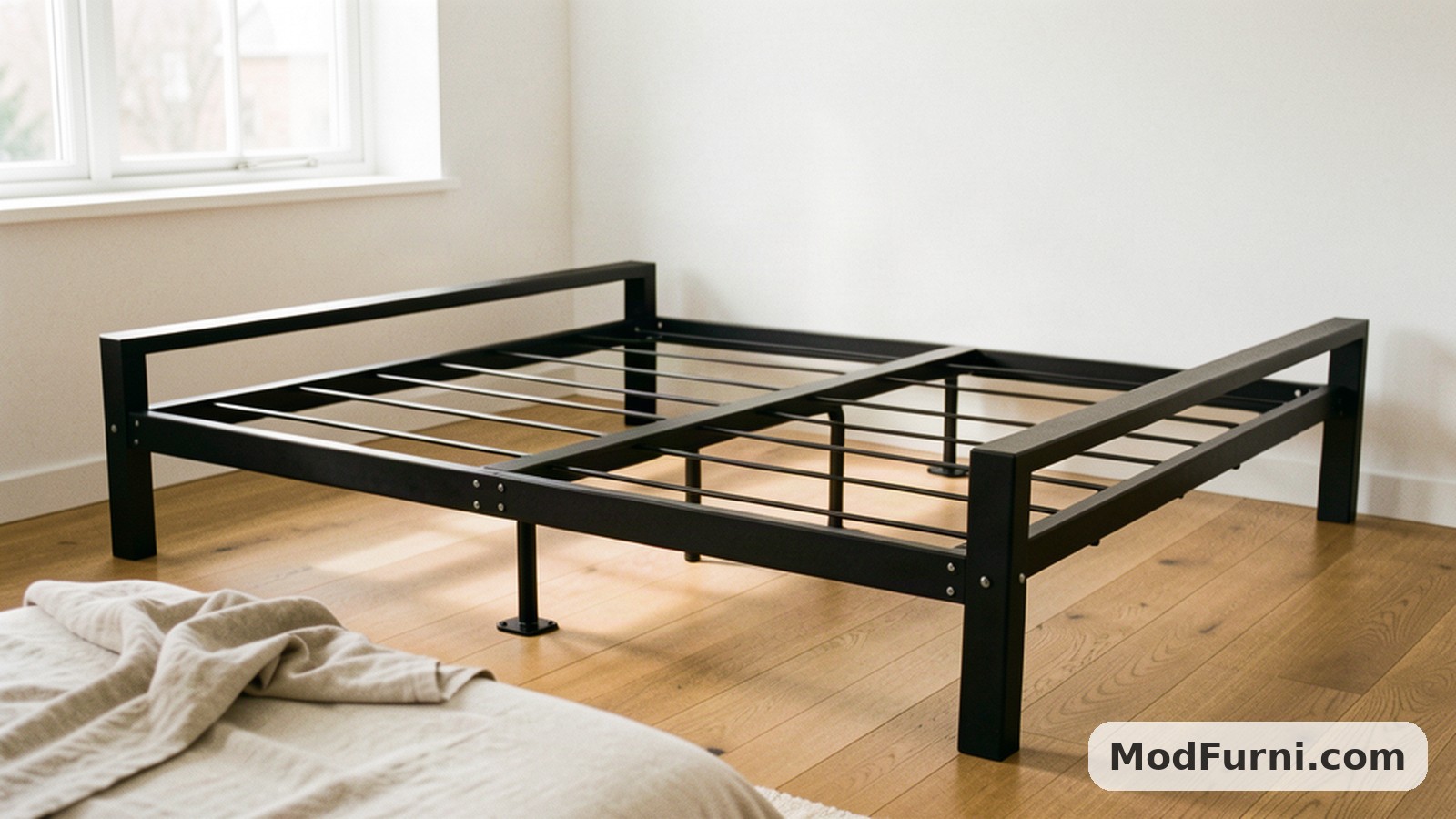
A metal bed frame is a steel, iron, or aluminum base that carries a mattress on rails and slats. Whether it counts as sturdy in 2026 depends far less on the metal itself than on tube wall thickness, leg count, center support, joint type, and slat spacing.
Two frames can both be described as heavy-duty steel and still behave nothing alike. One holds a queen mattress on nine legs and never moves; the other creaks by the third month because its center rail hangs a quarter inch above the carpet. The metal is the same material in both cases. What differs is how much of it there is, where it lands, and how it is fastened.
Below is a spec-by-spec walk through of what makes a metal frame genuinely solid, the weight ratings that published listings actually quote, and a ten-minute check you can run on a frame you already own.
Why “Sturdy” Is a Specification, Not a Material
Steel’s load capacity in a bed frame comes from section size, wall thickness, geometry, joint design, and support layout. A 1-inch square tube with a thin wall and a 1.25-inch rail are both steel, and they fail at completely different loads. That is why a manufacturer can print “heavy-duty” on a frame rated for 550 pounds and on another rated for 2,000, and technically be telling the truth twice.
A static rating is not the load your bed sees
Nearly every published capacity is a static rating: a fixed load applied to the frame and left there. A real bed takes a different kind of punishment — two people sitting down hard on one corner, a kid using the footboard as a step, a mattress that shifts every time someone rolls over. A static number still matters, because a frame rated well above the combined weight of sleepers and mattress has margin built in. It just is not a promise about motion, torque, or a missing leg.
Read the small print on scope. One manufacturer’s published limit explicitly excludes mattress weight, which means a 700-pound rating on a 90-pound king mattress is really a 610-pound working budget for the people on it.
Joints and feet fail before the tube does
In practice, metal frames rarely break at the middle of a rail. They loosen at the bolt holes, deform where a cross member meets a side rail, or rock because one foot sits on carpet and the next one does not. That is why leg count and center support quality matter more than the mill thickness of the main rail.
The Four Checks That Decide Whether a Frame Holds
If you only inspect four things before buying, make them these. The table below is the short version; every row is something you can confirm from a listing photo or the assembly PDF.
| Check | What a solid frame shows | What to walk away from |
|---|---|---|
| Center support | A center rail that runs head to foot, plus at least one leg reaching the floor at its midpoint on full, queen, and king sizes | Center rail with no leg, or a leg that stops short of the floor so it only touches once the mattress loads it |
| Leg count | Six legs on twin and full, nine on queen and king, with the extra pair at the center line | Four corner legs only, which puts the entire span of a queen rail in bending |
| Slat spacing | Gaps of roughly 3 to 4 inches or tighter, or a manufacturer figure the mattress maker accepts | Wide gaps that leave foam or latex unsupported between slats |
| Joint hardware | Bolted or welded joints with locking washers, plus foam tape or rubber pads where steel meets steel | Slip-fit brackets and bare metal-on-metal contact at every slat |
Weight rating belongs on that list too, but it is the last thing you can use to compare one frame against another, not the first. More on that below.
What Published Weight Ratings Actually Mean
Current listings cluster in a wide but readable band. Documented examples we could trace to a specification or retailer page include 300 to 500 pounds for twin frames, 350 to 800 pounds for full, 450 to 800 pounds for queen, and 550 to 800 pounds for king. One manufacturer’s published guidance sits at 350 pounds for twin and twin XL, and 700 pounds for full through California king — a tighter, more conservative table than many retailers print.
Above that band, capacity claims get harder to evaluate. A steel twin platform frame from VASAGLE lists six legs with center reinforcement at 550 pounds total static load — a modest number for a design with good support geometry, which suggests the figure is honest rather than inflated. Meanwhile some listings advertise 1,500 pounds for an adjustable frame with 1.25-inch rails, 2,000 pounds for a heavy-duty iron king platform, and up to 3,000 pounds on other platforms. Those numbers may all be accurate; the problem is that they are not produced by a common test, so comparing them side by side tells you very little.
One useful reference point: the VASAGLE steel twin platform frame is the sort of mid-band design where the rating can be checked against visible construction — six legs, center reinforcement, and a stated static load that matches what the photo shows.
No standard converts “metal bed frame” into one strength rating
ASTM F1427-21 is the consumer-safety specification people sometimes cite in these discussions, and it does not do what shoppers assume. It covers bunk beds, including foundation supports and metal frame fastenings. It says nothing about how much weight a standalone platform bed carries. For a non-bunk frame, the manufacturer’s own capacity statement, assembly instructions, and warranty are the only documentation you have — so read them, and ask for the test method if you need a high limit.
Slat Spacing: The Spec That Quietly Voids Warranties
Support quality is decided between the rails, not at them. Documented slat gaps on current frames run about 5.3 to 5.7 inches on one model and 5.4 to 5.9 inches on another, while general buying guidance points to 3 to 4 inches or tighter. Wirecutter’s repair guidance flags innerspring mattresses at risk once slats are more than 2.5 inches apart.
The mattress maker has the final word, and the answer differs by construction. Foam and latex mattresses need closer, flatter support than a coil mattress with a rigid border, because a soft slab will dip into any gap it can find. A metal bed frame with wide slats plus a memory foam mattress is the combination we see most often in complaints about sagging, and it is almost never the frame’s fault in isolation.
If you are matching a new frame to an existing mattress, check the mattress warranty language before you order. A frame that meets the mattress maker’s spacing requirement keeps the warranty intact; one that does not gives the manufacturer an easy reason to decline a sag claim.
Fit Matters as Much as Strength
A sturdy frame in the wrong size is still a bad purchase. Mattress dimensions are fixed — twin at 39 by 75 inches, full at 54 by 75, queen at 60 by 80, king at 76 by 80, California king at 72 by 84 — but frame dimensions are not. What you need is the inside support area, which is normally smaller than the overall footprint. One queen listing gives an 80 by 60 inch mattress fit inside an 83 by 61 inch overall frame; our own 85×61 inch queen metal platform bed publishes both figures so the difference is visible before you buy.
Under-bed clearance is the other measurement that gets misread. Documented clearances run 8, 10, 12.6, and 16 inches depending on the model. Confirm that the number quoted is usable storage height rather than total frame height, or the bins you bought to fit underneath will not slide in.
How to Tell in Ten Minutes Whether Your Frame Is Sturdy
Run this on any assembled metal frame, new or old. It assumes the mattress is on and the bed is against a wall.
- Shake the head end. Grip the top of the headboard and push gently side to side. A solid frame moves as one unit. A marginal one flexes at the corner brackets and you can hear the joint move.
- Look for daylight under the center leg. Get at floor level and check that every leg bears weight. A leg hovering a fraction above the floor is the single most common cause of a queen frame that dips in the middle.
- Test the diagonal. Measure corner to opposite corner across the frame. Matching diagonals mean the frame is square; a frame that is out of square will rock no matter how tight the bolts are.
- Check every bolt by hand. Loose fasteners are normal after the first month as the frame settles. Snug them, do not force them — overtightening strips threads and deforms thin tube walls.
- Listen at the slats. Squeaks usually come from metal rubbing on metal where slats meet rails. Felt pads or a strip of tape at those contact points removes most of it.
If a leg is bent, a rail is visibly bowed, or a weld has started to crack, stop using the frame. Those are structural failures, not setup issues, and no amount of tightening fixes them.
What to Buy If You Want Margin
The safest purchase is unglamorous: a frame whose stated capacity comfortably exceeds the combined weight of mattress and sleepers, with a center rail that reaches the floor and slat spacing your mattress maker accepts. Size changes the math — a king needs more center support than a twin for the same sleeper weight, because the rail span is longer.
Our metal bed frame collection lists inside dimensions and support layout for each model, which is the information that decides the question. If you want the walk-through for one specific size, the guide to metal queen frames with headboards covers ratings and rail construction in detail. For a low-profile look, the platform bed range keeps the same support structure without the tall footboard.
One last comparison worth knowing: a flat-slat metal platform with 3-inch gaps and a 14-inch clearance is a genuinely different product from a decorative iron bed with four legs and a 5.5-inch gap. Both are metal. Only one is built to carry a heavy mattress for a decade. The Zinus 14-inch Elias metal platform frame sits at the practical end of that spectrum, with a slat deck designed to stand in for a box spring.
Frequently Asked Questions
Are metal bed frames as sturdy as wooden ones?
For load capacity, usually yes. Steel platforms with nine or more support legs routinely carry more than comparably priced solid wood beds, and welded or bolted steel holds its shape for years. Wood can be quieter out of the box because wood-on-wood contact does not ring the way steel-on-steel does, but that gap closes with foam-padded joints and rubber foot caps.
What weight can a metal bed frame hold?
Published ratings vary widely by size and model. Documented examples run 300 to 500 pounds for twin, 350 to 800 for full, 450 to 800 for queen, and 550 to 800 for king, with premium frames advertising substantially more. Check whether the figure includes the mattress and whether it is a static rating, since one cited manufacturer excludes mattress weight entirely.
Why does my metal bed frame squeak if it is sturdy?
Noise almost always comes from loose joints or metal rubbing at slat and rail contact points, not from weak tubing. Tighten the bolts by hand, confirm the frame is square and level, and add felt or tape where steel meets steel. A frame that still squeaks after that usually has a fastener that cannot stay tight, which points to a stripped thread or an oversized hole.
Do metal bed frames need a box spring?
Most do not. A metal platform frame with a slat deck is designed to support the mattress directly, and adding a box spring on top raises the sleeping surface without improving support. Check the slat spacing against your mattress warranty first; if the gaps are wider than the mattress maker allows, a thin foundation is the correct fix rather than a full box spring.
How can I tell if a metal bed frame is heavy-duty before buying?
Look at leg count, center support, and the published inside dimensions rather than the phrase heavy-duty. Six legs on twin and full, nine on queen and king, with a center rail leg that reaches the floor, is the pattern to look for. A stated static capacity with a described test basis is worth more than a large number with no conditions attached.