
Buy Guide
Wooden Bed Frame Queen With Headboard: Sizes and Specs
Nov
Wooden Bed Frame Queen With Headboard: Sizes, Materials, and What to Check Before You Buy
A wooden bed frame queen with headboard carries a standard 60 × 80 inch mattress on wood or plywood slats, with the headboard fixed at the top end. Frames in current listings measure 80 to 85.5 inches long and 62.4 to 64 inches wide outside.
The gap between those two numbers — the mattress and the frame around it — is where most of the buying mistakes happen. A queen frame can be five inches longer than the mattress it was sold for, a headboard can disappear behind a thick mattress, and a bed listed at 800 pounds can share nothing but a label with one listed at 400. What follows is the measuring sequence we use before recommending any queen wood bed, in the order we would actually check it in a showroom.
Start With the Mattress, Then Measure the Frame Interior
A U.S. queen mattress is 60 inches wide and 80 inches long. That is the only fixed number in this decision; everything else is the frame’s own geometry. Listings quote a “platform” or “sleeping space” separately from the overall dimensions, and the two are easy to confuse when you are reading a product page on a phone.
Take the Costway wooden platform bed. The listing gives 84 × 64 × 37.5 inches overall and a platform of 81 × 61 inches, sized for a 60 × 80 inch queen mattress. The platform is one inch longer and one inch wider than the mattress; the rest of the overall figure is rails and a footboard.
Normal is not universal. One review roundup notes a specific model running about five inches longer than the mattress it was paired with, which shows up as exposed wood at the foot and a mattress that slides forward every night. Read the interior platform dimensions and the distance from the inside of the headboard to the inside of the footboard. If a listing gives only overall dimensions, assume the difference is spread unevenly and confirm with the seller before assembly, because a bed frame is a heavy box to send back.
Mattress thickness changes what the headboard does
Headboard height and mattress depth are a single decision, not two. A 36.5-inch headboard with a 12-inch mattress leaves roughly two feet of visible wood above the bedding; the same headboard with an 8-inch mattress shows four more inches of panel and changes how tall the bed reads in the room. Costway recommends a mattress of 8 inches or less for its curved-headboard queen, while the GIANTEX bed suggests 8 to 12 inches. Neither is right or wrong — they are built to different headboard heights.
The Footprint Numbers Behind the Word “Queen”
Two footprints in the table below mark the ends of the range. The Christopher Knight Home frame is listed at 80 × 62.4 × 47.25 inches overall; the Plank+Beam solid-wood bed is listed at 85.5 × 64 × 36.5 inches. Under-bed clearance is the other number that decides how a bed lives in a room. The table below lists it for every frame, and the gap between a low platform and a hotel-height build changes what you can store underneath — boxes, out-of-season bedding, or nothing but a vacuum robot.
| Queen wood bed | Overall (L × W × H) | Platform space / clearance | Stated capacity |
|---|---|---|---|
| Costway wooden platform bed | 84 × 64 × 37.5 in | 81 × 61 in platform; 12 in ground clearance | 400 lb |
| GIANTEX wooden bed | 83.5 × 62 × 39.5 in | 6 in under-bed clearance | 660 lb |
| Plank+Beam solid-wood bed | 85.5 × 64 × 36.5 in | Fits a standard 60 × 80 in queen mattress | 750 lb |
| Christopher Knight Home wooden bed | 80 × 62.4 × 47.25 in | 7.8 in under-bed clearance | 550 lb |
| Acacia Haven solid-wood bed | 83.9 × 63.1 × 46.5 in | Queen mattress compatibility stated | 800 lb |
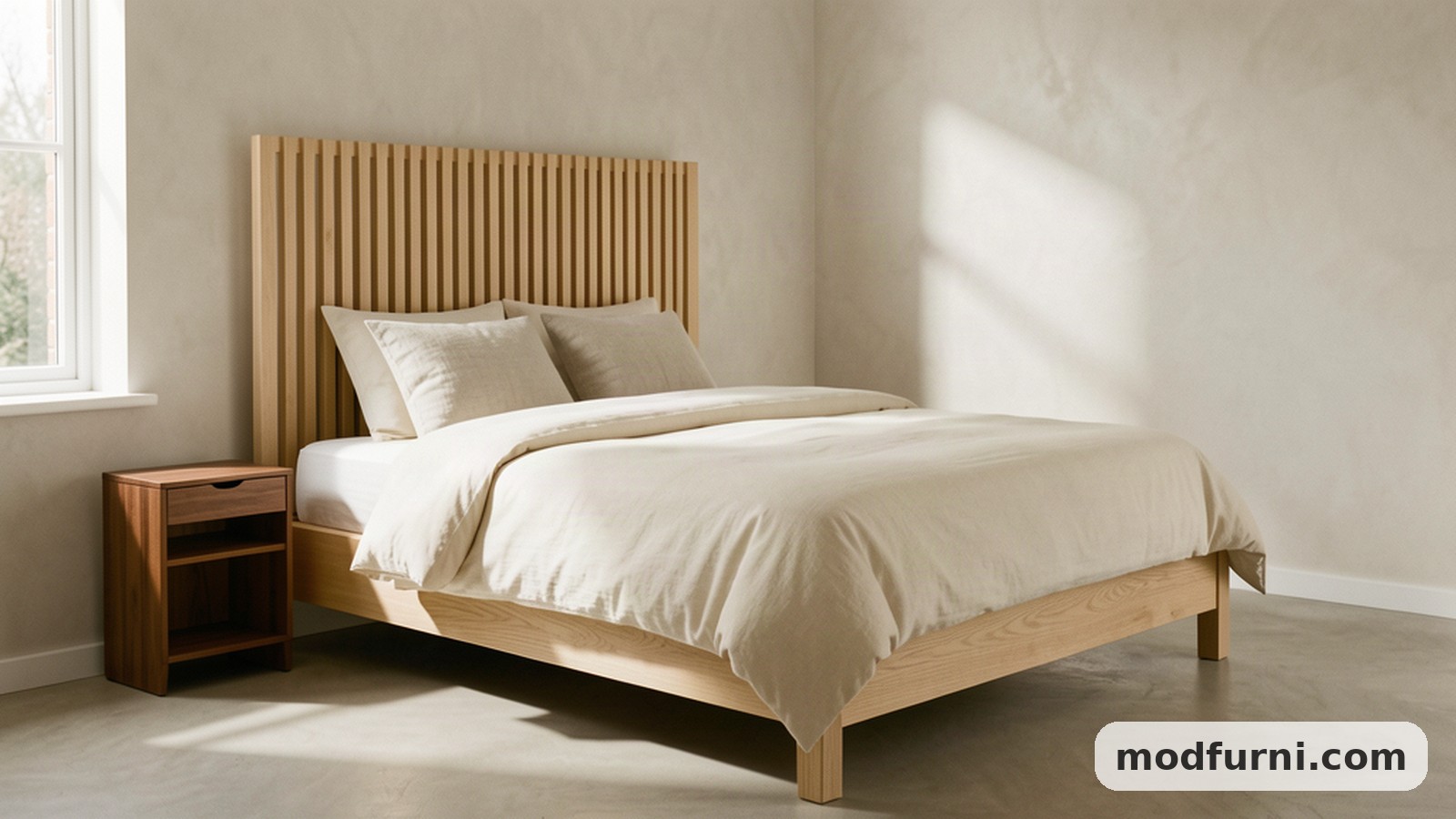
| ModFurni queen wood bed with headboard | 83.23 × 60.82 × 51.18 in | Platform, no box spring required | 800 lb |
Two practical checks come out of that table. First, the longest footprint in it is 85.5 inches, so plan on roughly that much wall — in a 10 × 10 foot bedroom the frame leaves about 34 inches of floor at the foot before a dresser goes in. Second, height matters as much as length. The Christopher Knight Home headboard reaches 47.25 inches overall while the Plank+Beam bed stops at 36.5 inches, and the taller of the two will crowd a window sill that the shorter one clears.
Solid Wood, Plywood, MDF: What the Material Label Hides
Few queen beds at retail are one material. A typical mixed build uses solid wood for the rails and legs, plywood for the slats, and MDF or particleboard for the headboard panel. That is a reasonable way to build a bed — the parts that carry load get solid stock, and the parts that only need to be flat get engineered panels.
The label still tells you less than the assembly does. “Solid wood” on a listing can mean pine, poplar, or rubberwood, and strength varies by species, grain direction, and how thick the rail actually is. Our own wood bed frame collection lists P2-grade MDF panels over a metal frame with wood slats, which is common at this price band and works when the slat deck and center support are specified properly.
Slats do more work than the headboard
Slat complaints in the review set are about fit and spacing rather than species. Owners of one Target-listed frame complained of crooked or too-short slats and unstable support, and reviewers warn that wide gaps let foam and hybrid mattresses sag between them. Check the slat spacing against your mattress maker’s warranty language, and look for a center rail with a leg that reaches the floor on a queen — the span is long enough that a center support is structural, not decorative.
Engineered panels and the formaldehyde question
MDF and particleboard are bonded with resin, and composite wood sold in the U.S. falls under the federal formaldehyde limits in 40 CFR Part 770, the TSCA Title VI rule. A seller who can point to a compliance statement is telling you the panels were made to that standard; a seller who answers “it’s eco-friendly” is not. This is a paperwork question you can ask before ordering, and it costs nothing to ask.
Weight Ratings, Read Correctly
Published queen capacities in our research set run from 400 pounds on the Gymax pine bed to 800 pounds on the Acacia Haven frame, with the Christopher Knight Home bed at 550 and the Plank+Beam solid-wood bed at 750. A GDFStudio Alden queen platform built from particleboard, MDF, pine, and plywood is listed at 1,000 pounds. The spread within similar footprints is larger than the frames themselves, which is the first hint that these numbers are not produced by one test.
Most are static ratings: a fixed load left in place. A bed in use takes corner drops, a knee on the rail while you change sheets, and a mattress that shifts. A rating well above the combined weight of sleepers plus mattress gives you margin, but it does not describe motion. Read the scope note too — at least one manufacturer’s limit explicitly excludes mattress weight, so a 700-pound rating under a 90-pound king mattress leaves a 610-pound working budget for people.
The Christopher Knight Home queen bed with headboard is a useful reference point at the middle of the band: 550 pounds, a 7.8-inch clearance, and a footprint of 80 × 62.4 inches, all of which you can check against the listing photos. At the top of the band, the Acacia Haven queen bed and headboard is listed at 800 pounds in a caramel finish over a 46.5-inch headboard.
Two Queen Wood Frames, Measured and Priced
Our own catalogue is a fair place to test the checklist, because the dimensions are published rather than implied. The ModFurni wood queen bed frame with headboard measures 83.23 × 60.82 × 51.18 inches, ships at $214.11, needs no box spring, and carries an 800-pound rating with a 45-minute assembly estimate from the factory. The 51.18-inch height puts it at the tall end of the range in the table above, so it suits a room with high ceilings or a bare wall behind the bed.
The queen size wood platform bed frame is the lower-profile option at $200.16: 82.83 × 60.00 × 49.86 inches, solid wood slats over a metal frame, and one box instead of two. If you are shopping by size rather than by design, the queen bed frame category filters the same construction across headboard and storage variants.
Assembly Day: Two Hours, One Box, Four Tools
Knock-down packaging is normal in this category, and it is not a quality signal either way. What matters is whether the hardware is bagged by step and whether the parts are labeled. Our own queen frames are numbered so the sequence matches the diagram; the factory estimate of 45 minutes assumes one person who has read the instructions first.
Three things cause the squeaks that owners report in the first month. Bolts loosen after the wood settles, so a re-torque at the two-week mark is worth the ten minutes. Slats move against bare rails, which a strip of felt or foam tape stops. And a center leg that hangs a quarter inch above the carpet will slap the floor every time someone sits down — check it with a level before you put the mattress on.
Frequently Asked Questions
Does a queen wooden bed frame with headboard need a box spring?
Not if it has a slat deck. All the frames in the table above are platform builds that support a mattress directly, and adding a box spring on top would raise the sleeping surface by 8 to 9 inches and hide more of the headboard. Use a box spring only with a frame that specifies one, or with an older mattress whose warranty requires it.
What mattress thickness works with a queen bed that has a headboard?
Match the thickness to the headboard height. Listings in our research set recommend anywhere from 8 inches or less up to 8 to 12 inches, depending on how tall the panel is. A 36-inch headboard with a 12-inch mattress leaves about two feet of visible wood; the same mattress under a 47-inch panel leaves closer to three.
How much weight does a wooden queen bed frame hold?
Published limits on the queen frames we traced range from 400 to 800 pounds, with one particleboard-and-pine platform listed at 1,000. Treat the figure as a static rating for that model, check whether mattress weight is included, and prefer a frame with a center rail plus a floor-reaching center leg on a queen span.
Will a 60 × 80 inch mattress fit any queen frame?
It will fit the platform, but not always neatly. Overall footprints run 80 to 85.5 inches long, so some frames leave exposed wood at the foot and a mattress that creeps forward. Compare your mattress dimensions with the frame’s interior dimensions rather than the “queen” label on both.
How do I keep a wooden bed frame from creaking?
Re-tighten the bolts after the first two weeks, put felt or foam tape between the slats and the rails, and confirm the center leg touches the floor with the bed empty. Most creaks come from movement at a joint or a slat, not from the wood itself.