
Buy Guide
Platform Bed with Under Storage: Drawer Travel and Clearance
Nov
Platform Bed with Under Storage: Drawer Travel, Clearance, and What Actually Fits
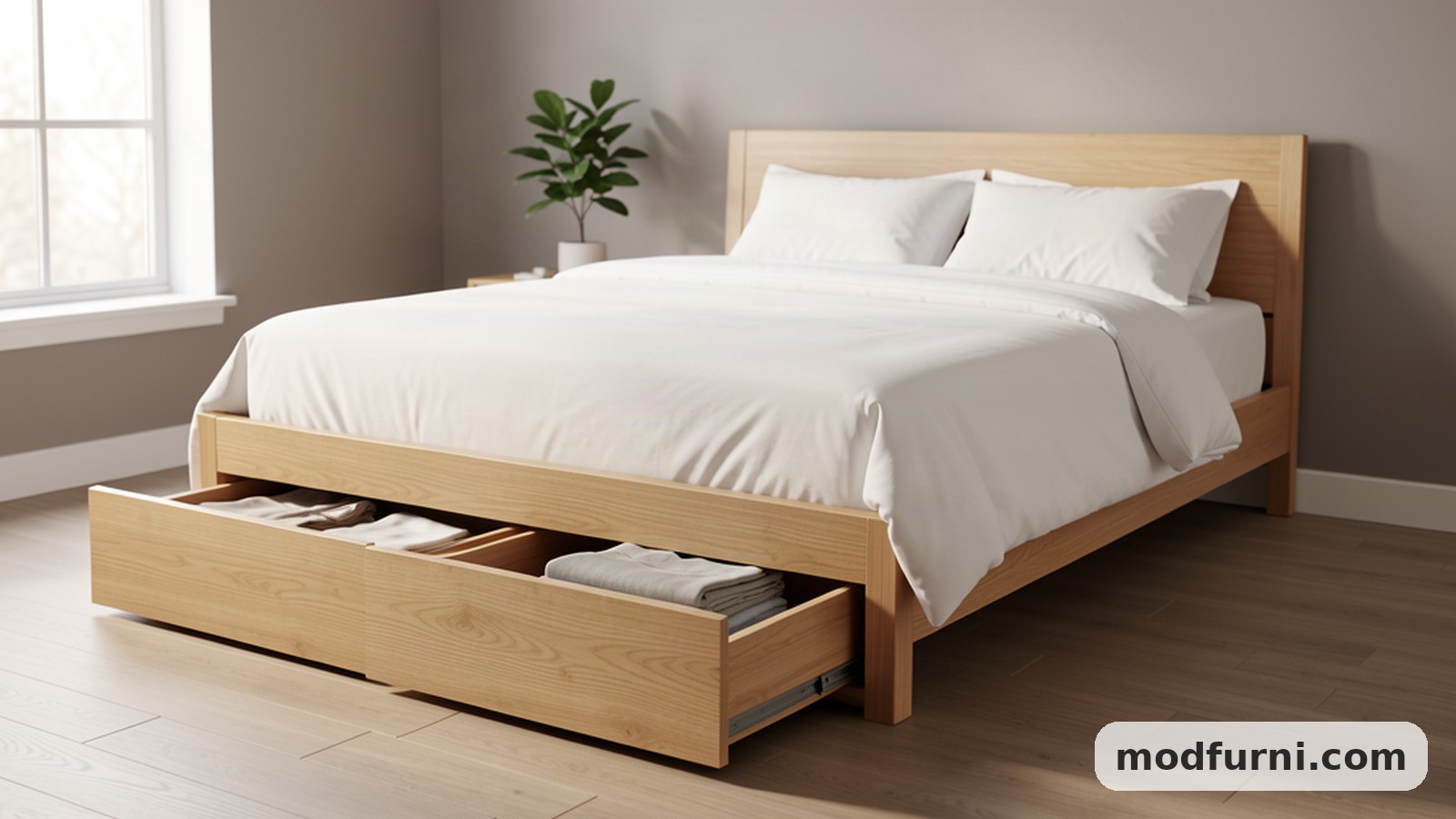
A platform bed with under storage uses the space below its slat deck for pull-out drawers, loose bins, or a lift-up cavity instead of leaving it empty. Listed clearances run from about 6 to 12 inches, and enclosed drawer boxes run roughly 6 to 8 inches deep.
Almost every disappointment in this category comes from a measurement taken in the wrong direction. Buyers measure the bed’s footprint against the wall and stop there, then discover that a drawer needs two feet of open floor to slide into and the nightstand is in the way. The numbers that matter are the drawer’s travel, the gap between the deck and the floor, and the height of the whole assembly — three figures that listings bury in different places, or omit.
Measure the Drawer’s Travel Before the Bed’s Footprint
A storage drawer has to leave the frame entirely. The distance it travels is roughly its depth, which means a queen frame with 20-inch drawers needs 20 inches of clear floor on the side you plan to open — and that clear floor has to stay clear, because a bedside table parked there blocks the drawer permanently. Both Forbes and The Spruce single this out as the most common storage-bed mistake: the drawers are fine, the room around them is not.
Sizes are published per model, so the figure is checkable. The Phoenix wood platform bed’s queen drawers measure 20.55 inches deep by 39.37 inches wide by 8.07 inches tall; the Wesley platform bed’s queen drawers are 20.55 by 39.76 by 8.07 inches. Those two numbers are close because the beds share a drawer supplier. A six-drawer queen from Zifone, by contrast, splits storage across both sides and the foot, so no single drawer is as deep.
Side drawers versus end-opening and lift-up designs
Where the drawer opens decides whether the bed can sit against a wall. Side-opening drawers need clearance on both long sides, which rules out a bed pushed into a corner. End-opening drawers pull toward the foot of the bed and leave one long side free. A lift-up frame — the whole mattress platform rises on gas struts — needs no drawer travel at all, just enough headroom for the deck to tilt up and a few feet of open floor at the foot.
If the room is tight on one side, the practical answer is a mixed design rather than a smaller bed. The AFI NoHo queen platform bed ships with two free-floating under-bed drawers that can be positioned on either side, which lets you put both on the open side of a corner placement. The listing gives 81.5 × 60.25 × 47.63 inches overall and an 800-pound capacity.
The Clearance Numbers Behind “Under-Bed Storage”
Open clearance and enclosed drawers are not the same product, and the gap between them is where buyers get surprised. A frame advertising “under-bed storage” may mean nothing more than 6 inches of air, enough for flat bins and nothing else. Our research set has one Costway queen platform bed at 6 inches of under-bed clearance with a 660-pound rating, a GDFStudio queen with 8.2 inches and an 800-pound rating, and a Slickblue steel frame claiming 12 inches underneath.
Two distinctions do the work here. First, clearance is measured to the lowest structural member, not the rail, and a center support leg sitting in the middle of the span interrupts a long bin. Second, drawer height is a separate figure from frame clearance, and it runs smaller on every model in our set: the Phoenix and Wesley queens list 8.07-inch-tall drawers, and the queen storage platform bed lists drawers 6 inches tall. If you need to store duvets and suitcases, an open deck or a lift-up frame suits those items better than a shallow drawer.
Height is the other number that changes the feel of a room. In our research set, low-profile storage platforms sit at 9.5 inches overall while headboard models reach 33.46 to 47.63 inches. The same queen mattress on a 9.5-inch base and on a 47-inch headboard bed are two different bedrooms, and neither one is more correct.
A 9.5-inch platform and a 47-inch headboard are both “queen”
Overall height is quoted from the floor to the top of the tallest part, so a low platform and a full headboard bed can differ by more than three feet while accepting the same 60 × 80 inch mattress. Read the height against your window sills and wall outlets before ordering, and check the platform height separately if you care where the mattress top lands. A 9.5-inch platform with a 10-inch mattress puts the sleeping surface at roughly 20 inches, which is low enough that some buyers add a thicker mattress to compensate.
| Model | Overall footprint (L × W × H) | Storage dimensions | Stated capacity |
|---|---|---|---|
| Zifone queen, six drawers | 81.7 × 62.2 × 17.7 in | Six full-extension drawers | 500 lb |
| Phoenix wood platform, queen | 86.28 × 64.96 × 37.99 in | Drawers 20.55 × 39.37 × 8.07 in | 800 lb |
| Wesley platform, queen | 82.76 × 64.57 × 33.46 in | Drawers 20.55 × 39.76 × 8.07 in | 800 lb |
| Costway queen platform | 83.5 × 62 × 39.5 in | 6 in under-bed clearance | 660 lb |
| AFI NoHo queen, two drawers | 81.5 × 60.25 × 47.63 in | Two repositionable drawers | 800 lb |
| ModFurni queen wood platform | 82.83 × 60.83 × 44.13 in | Open under-bed storage | Not published |
The spread in that table is not noise. A 17.7-inch six-drawer bed and a 47.63-inch headboard bed are built for different rooms, and the capacity column moves between 500 and 800 pounds for frames that look similar in a photo. The Zifone six-drawer queen is the low-profile case: 81.7 × 62.2 inches at 17.7 inches tall, 500 pounds, with six drawers and a recommended mattress thickness of 8 to 10 inches.
What the Storage Cavity Is Actually Made Of
Drawers are the part of a storage bed that gets handled every day, and they are usually the least structural part of the build. Particleboard and MDF are normal for drawer boxes and headboard panels, with solid wood or LVL used for rails and slats. A GDFStudio platform in our set blends solid wood, MDF and plywood across a 400-pound full and an 800-pound queen. A rubberwood queen pairs rubberwood with MDF and LVL plywood over 12 LVL slats and 10 support legs.
Composite panels are bonded with resin, and furniture sold in the U.S. falls under the formaldehyde limits in 40 CFR Part 770, the TSCA Title VI rule. Asking a seller for a compliance statement is a reasonable pre-purchase question and costs nothing. “Eco-friendly” is not an answer to it.
Slats and support legs carry the load, not the drawers
Every capacity figure in this category is a manufacturer claim until someone publishes a test report. The counts are still worth reading: 12 slats and 10 legs on the rubberwood queen, 14 slats and 14 legs on a HOMCOM particleboard-and-MDF queen rated 660 pounds, nine legs and a center bar on the Slickblue steel frame that claims 3,500 pounds. That last number is roughly five times the next highest in the set, which is a reason to ask what was tested rather than a reason to believe it.
There is a federal reference point, though not a certification. The GSA publishes test requirements for bunkable and loftable beds, beds with drawers, and drawer units for use under beds, covering bed-end impact, cyclic deck durability and deck-frame racking. It is a procurement document for the beds it names, and no retail listing in our research set claims to meet it.
Storage Beds in Our Own Catalogue, Measured
Two frames in our range show the two ends of the storage decision. The modern queen bed frame with storage headboard is 87.01 × 60.79 × 42.20 inches, ships at $236.48, and pairs two rolling under-bed drawers with shelving in the headboard plus USB ports and a reading light — storage in two places, which is what a small bedroom usually needs. The 87-inch length is the number to check against your wall; it is longer than most of the frames in the table above.
The queen size wood platform bed takes the other approach at 82.83 × 60.83 × 44.13 inches and $183.02, with no drawers and a deliberate gap under the frame for bins. It ships in one box and the factory estimates 45 minutes for assembly. If you would rather compare drawer counts and finishes across the range, the platform bed collection lists every storage variant we carry, and the queen size category filters the same frames by footprint.
What Fails First on a Storage Bed
Drawer hardware, not the frame. Review summaries in our research set report caster-mounted drawers drifting out of alignment, failing to sit flush, and behaving worse on uneven floors. Track-mounted drawers hold their line better over years of daily use; casters are cheaper and more forgiving to install. If the drawer runs on casters, the floor under the bed matters as much as the drawer.
The frame failures are ordinary and fixable. Bolts loosen after the wood settles, so a re-torque at the two-week mark prevents most squeaks. Slats rub against bare rails until a strip of felt goes between them. A center leg hanging a quarter inch above the carpet will slap the floor every time someone sits down, so check it with a level before the mattress goes on. A storage bed has more parts than a plain platform, and every extra part is a fastener that can work loose.
One more check that is easy to skip: confirm the platform is designed to be used without a box spring. All the frames here are slat decks, and adding a box spring raises the mattress several inches above the deck, which changes the headboard proportion and, on a low-profile bed, puts the mattress where the drawers are meant to clear.
Frequently Asked Questions
How much clearance do I need under a platform bed for storage?
Measured clearances in our research set run from 6 inches on a Costway queen to 12 inches on a Slickblue steel frame, with 8.2 inches on a GDFStudio queen. Compare that figure to the height of the bins or cases you plan to slide under, and remember that a center support leg breaks the span into shorter compartments.
Do platform beds with under storage need a box spring?
No. These are slat-deck platforms that support a mattress directly, and a box spring would sit on top of the deck and raise the sleeping surface by several inches. Keep the platform bare unless your mattress warranty explicitly requires a foundation — the box spring guide walks through the exceptions.
Can I push a storage bed against a wall?
Only if the drawers open somewhere else. Side-opening drawers need clear floor on both long sides, so a wall-backed bed loses half its storage. End-opening drawers or a lift-up deck solve this; the AFI NoHo’s repositionable drawers are another way out, since both can be moved to the open side.
Are under-bed drawers strong enough for bedding and clothes?
Manufacturers rarely publish drawer load limits, which is why the frame rating is a poor guide. The Zinus Maya platform bed uses four locking drawers on a 10-inch frame listed at 2,200 pounds, and that figure describes the bed, not the drawers. Linen and clothing are light; books and tools are not, and a drawer on casters will tell you which one you loaded.
What is the difference between under-bed drawers and a lift-up storage bed?
Drawers give you frequent, partial access — you reach in from the side without clearing the bed. A lift-up deck raises the whole mattress on struts and gives one large cavity for suitcases and seasonal bedding, at the cost of needing the bed clear and enough headroom to tilt the deck. Rooms with one blocked side usually suit lift-up better than drawers.