
Buy Guide
King Bed Frame Buying Guide: Dimensions, Materials, and Fit
Aug
King Bed Frame Buying Guide: Dimensions, Materials, and Fit
A king bed frame is a sturdy base designed to support a king mattress that measures 76 by 80 inches, the widest common size in American homes. It carries the full weight of the mattress and sleepers without flexing, making it ideal for couples who want extra sleeping space.
King size beds are the most popular option for couples who want extra space. Each sleeper gets roughly the same width as a twin mattress, which means less elbowing at 3 a.m. and more room to spread out. But a king frame also takes up serious floor space, so the decision starts with measurements, not aesthetics.
King Bed Frame Dimensions: What You Are Actually Buying
A standard king mattress is 76 inches wide by 80 inches long, and the frame that holds it runs slightly larger. Most king bed frames add 1 to 3 inches on each side and at the foot, so plan for an overall footprint of roughly 80 by 84 inches. That matters when you are working with a tight bedroom layout.
Here is how the standard king compares with the other common sizes:
- King: 76 by 80 inches (frame roughly 80 by 84 inches)
- California King: 72 by 84 inches (longer and narrower, for tall sleepers)
- Queen: 60 by 80 inches (the most common US size)
- Full: 54 by 75 inches (good for single adults and kids)
Before you order, measure the bedroom with the frame in place. You want at least 24 inches of walkway on each side so you can make the bed without climbing over it. A standard king works best in a room that is at least 12 by 12 feet, and 13 by 13 feet feels noticeably more comfortable. If your room runs narrow, a California king frame saves 4 inches of width while adding 4 inches of length, which suits tall couples better anyway.
Types of King Bed Frames
Every king frame falls into one of four broad categories, and each one serves a different budget, style, and support need.
Platform King Bed Frames
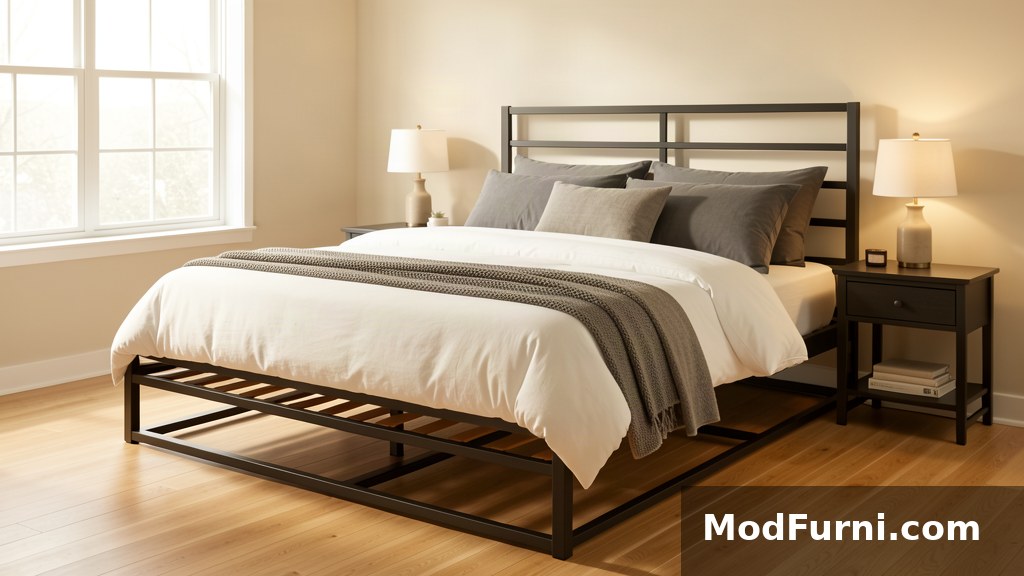
A platform frame uses wooden slats or a solid deck to support the mattress directly, so you never need a box spring. Most sit 12 to 18 inches off the floor, which gives the bedroom a clean, modern line. Slats spaced 2.5 to 3.5 inches apart work with almost any modern mattress, including memory foam, hybrid, and latex. Brands like Zinus and SHA CERLIN dominate this category, with prices from $200 to $500 for a king. It is the easiest setup for most shoppers because it is one piece and done.
Metal King Bed Frames
Metal frames are the workhorses of the category. They are built from welded steel, they hold 800 to 3,500 pounds depending on the gauge, and they rarely creak once assembled. Olee and Yaheetech make popular low-profile versions that sit 7 to 14 inches high and fold flat for moving. If you want a headboard and footboard, you buy them separately, which is how many metal frames stay so affordable. Expect to pay $120 to $350 for a king, and double-check the slat spacing if you plan to put a memory foam mattress on top.
Upholstered King Bed Frames
An upholstered frame wraps the headboard, footboard, or both in fabric over foam padding. Linen, velvet, and faux leather are the usual choices, and the padded headboard makes a real difference if you read or watch TV in bed. DHP and Allewie make mid-range versions with tufted detailing from $400 to $900, while higher-end picks from Novogratz push past $1,000. Upholstered frames are usually platform-style underneath, so they still work without a box spring. The tradeoff is maintenance: fabric headboards collect dust and need occasional vacuuming.
Storage King Bed Frames
A storage frame builds drawers, shelves, or a hydraulic lift platform into the base, turning dead space under the bed into usable storage. Lift-up designs hold the most, giving you access to the entire 76-by-80-inch footprint, while drawer versions are easier to reach day to day. Storage frames cost more, typically $500 to $1,200 for a king, and they add 2 to 4 inches of height. They are a strong choice for small bedrooms where a dresser simply will not fit.
How to Choose the Right King Bed Frame
Work through these steps in order and you will land on a frame that fits both the room and the way you sleep.
- Measure the room and the hallway. Confirm the frame fits the bedroom with clearance to walk around, and check that it makes it through doorways and up stairs. A king frame box is long and awkward to carry.
- Match the frame to your mattress. Weigh your mattress and add the sleepers. A memory foam king can weigh 80 to 120 pounds on its own, so look for a frame rated at least 700 pounds total.
- Pick the height you want. Low frames sit 7 to 10 inches and feel modern. Standard frames sit 14 to 18 inches, which matches most box-spring-era habits and makes getting in and out of bed easier for older adults.
- Decide on storage. If you have a small closet, a lift or drawer frame pays for itself. If space is fine, skip the extra cost and weight.
- Set a budget with delivery in mind. King frames ship in long boxes with high freight costs, so factor that into the total. Many online retailers quote free shipping over a threshold, but heavy metal frames often carry a surcharge.
If you are still deciding between frame styles, our complete bed frame buying guide walks through every material in more depth, and the top 10 king bed frames list shows what is actually selling this year.
Weight Capacity and Construction Quality
King frames span a huge range of weight ratings, and that number tells you more about the frame than the price tag. A basic metal frame with 1-inch angle steel holds 600 to 800 pounds, which covers two average adults and a mattress. Heavy-duty frames use 1.5-inch or thicker steel and rated slats, pushing capacity past 1,500 pounds. The heaviest commercial-grade options, like the Wulanos heavy duty king frame rated at 3,500 pounds, use solid steel slats and center support legs that never sag.
Whatever the rating, the weak point is almost always the slats. Look for steel slats or wood slats at least 0.5 inches thick, spaced no more than 3.5 inches apart. Center support legs running down the middle prevent the classic dip that shows up in the first year on cheap frames. Avoid frames where the slats are thin stamped metal, because those bend under a heavy king mattress and the mattress starts to bow.
Does a King Bed Frame Need a Box Spring?
It depends on the frame, and this is the most common point of confusion in the category. Platform frames and metal frames with slats do not need a box spring; the mattress sits directly on the support surface. Upholstered frames are also platform-style in most cases, so they skip the box spring too. You only need a box spring or foundation when you buy a traditional rail-and-headboard frame with no center support, which is rare today.
For memory foam and hybrid mattresses, the slat spacing matters more than the box spring question. Foam can sag into gaps wider than 3.5 inches, so confirm the slat spec before you buy. If you already own a foundation, our mattress foundation vs box spring guide explains which setup actually protects your warranty.
King vs California King: Which Footprint Fits You
The standard king is the wider choice, and the California king is the longer one. If you are tall, or if your room is narrow but long, the California king’s 72 by 84 inches usually works better. If you sleep with kids or pets in the bed and want maximum width, the standard king wins. In practical terms, standard king sheets and frames are easier to find in stock, while California king bedding can be slightly pricier and less varied. Both need a room of at least 12 by 12 feet to feel right.
Frequently Asked Questions
What is the best height for a king bed frame?
Most buyers choose 14 to 18 inches, which matches the mattress height to create a bed that sits about 25 inches off the floor, an easy height to get in and out of. Lower frames around 7 to 10 inches give a modern look but can be awkward for older adults or anyone with knee issues.
Will a king mattress fit on a queen frame?
No. A queen mattress is 60 by 80 inches, and a king is 76 by 80 inches, so a king mattress overhangs the frame by 8 inches on each side. The mattress will sag and the frame will show underneath. Always match the mattress size to the frame size.
Do king bed frames need center support?
Any king frame over 60 inches wide should have center support legs or a reinforced center beam. King is 76 inches wide, so a center support is essential to prevent sagging under the heaviest part of the mattress where the sleepers lie.
How much should I spend on a king bed frame?
Budget metal frames run $120 to $350, platform frames run $200 to $500, and upholstered frames run $400 to $900. Spend at least $250 and you get a frame with proper slats and center support that should last 10 years or more.
Are platform king bed frames good for memory foam?
Yes, as long as the slats are spaced no more than 3.5 inches apart. Platform frames are actually the best match for memory foam because they provide a flat, ventilated surface that foam needs to stay cool and firm.
Final Thoughts
The right king bed frame balances three things: the footprint of your room, the weight rating your mattress needs, and the style you want to wake up to. Measure first, then match the frame to your mattress type, then let budget narrow the field. If you want a frame that is built to ignore sagging and creaking for a decade, the Wulanos heavy duty king frame on Amazon is a solid, heavily reviewed starting point that works with any mattress. A king frame is a once-a-decade purchase for most households, so it is worth buying one that fits the room and the way you actually sleep.