
Buy Guide
King Size Headboard for Adjustable Bed: Fit, Brackets, and Clearance

Oct
King Size Headboard for Adjustable Bed: Fit, Brackets, and Clearance
Definition: A king size headboard for an adjustable bed is a headboard at least 76 inches wide, matched to a king mattress, that either bolts to the adjustable base through a bracket kit or stands independently on the wall, so the mattress can rise and lower without dragging against the panel.
Buying a king size headboard for an adjustable bed is not a width problem – almost every king panel is wide enough. It is an attachment problem. The head section of an adjustable base travels through an arc, and a panel that is bolted to the wrong point on that base will pull away from the mattress, stress the frame, or block the incline entirely. This guide covers the measurements that decide fit, the three ways to mount a king headboard, and the checks to run before you order.
The width rule: 76 inches is the floor, not the target
A standard king mattress measures about 76 inches wide by 80 inches long. A headboard sold as king size is usually a little wider than the mattress so the edges do not disappear behind the bedding – one commonly listed example measures 79.5 inches wide, 43.9 inches high, and 3.3 inches deep, at 54.7 lb.
Two consequences follow. First, a “king” headboard narrower than 76 inches leaves the mattress edges exposed and looks undersized. Second, if you are buying a headboard-and-frame combination rather than a headboard alone, the frame’s outside dimensions are larger than the mattress it holds: one example lists 82 inches long by 79 inches wide by 42 to 46 inches high for an 80-by-76-inch mattress.
Quotable: A standard king mattress measures 76 inches wide by 80 inches long, so a headboard sold as king size should be at least 76 inches wide and is commonly listed near 79.5 inches wide. (Source: manufacturer product specifications collected in our sizing research.)
Mounted or freestanding: the three real options
There are exactly three ways a king headboard meets an adjustable base, and they fail in different ways.
1. Brackets on the adjustable base. The base carries headboard brackets that extend from its frame; the headboard bolts to those brackets. This is the cleanest look, but it depends entirely on the base accepting brackets and on the hole spacing matching the panel.
2. A surrounding bed frame. If you keep a decorative platform bed and drop the adjustable base inside it, the headboard belongs to the bed frame, not the base. Measure the frame’s interior length and width against the base, not the mattress size.
3. Wall-mounted or freestanding panel. The headboard is fixed to the wall or stands on its own legs behind the bed. Nothing is bolted to the moving base, so the mattress simply travels behind the panel. This is the option that survives a split king setup without stress.
For a look at how a frame with an incline mechanism is built, our king bed frame with head and foot incline lists a head angle from 0 to 61 degrees and a foot angle from 0 to 37 degrees. That range is the number you must clear: a headboard placed too close to the mattress will be struck by the head section long before it reaches 61 degrees.

The measurements that actually matter
The table below collects the figures that decide whether a king headboard works with an adjustable base. Every value is model-specific – use it as a checklist of what to look up, not as a universal specification.
| What you are measuring | Typical king figure | Why it decides the fit |
|---|---|---|
| Mattress footprint | 76 in wide x 80 in long | Minimum headboard width; also the space the base must occupy |
| Headboard panel (one listed example) | 79.5 in wide x 43.9 in high x 3.3 in deep; 54.7 lb | Height sets how far the panel rises above the mattress |
| Bed frame outside dimensions (one example) | 82 in long x 79 in wide x 42 to 46 in high | Built for an 80 x 76 in mattress; check interior, not exterior |
| Headboard-to-bedstead gap (one example) | 10 to 14 in | The clearance range the mattress needs as the head rises |
| Adjustable base section | 79.72 in long x 37.60 in wide per Twin XL half | A split king is two of these side by side |
| Whole-bed weight rating | 800 to 1,200 lb, model-specific | Applies to the bed or platform, not to a headboard panel alone |
What “universal” bracket kits do and do not guarantee
Headboard brackets sold for adjustable bases are commonly described as universal, and the description is doing less work than buyers assume. Universal usually means the bracket accepts a range of hole spacings, not that it matches your headboard’s hole pattern, your base’s rail height, or the fasteners your panel ships with. Owner reports of misaligned holes and screws that are too short come from exactly this gap.
Before ordering, collect three numbers from your base and three from your headboard: the distance between the base’s mounting rails, the height of those rails above the floor, and the bolt size the base’s bracket accepts; then the headboard’s hole spacing, the height of its mounting holes, and its total weight. If your base does not accept brackets at all, a TOPTGO headboard bracket kit for adjustable bed bases is the type of aftermarket adapter that fills that gap – confirm the hole spacing against your panel before you buy it.
Quotable: Listed capacities of 800 lb to 1,200 lb on adjustable beds and platform beds describe the whole bed system, not the headboard panel, so a headboard’s own load rating usually has to be treated as unspecified. (Source: manufacturer and retailer listings reviewed for this guide.)
Split king: the case that breaks a single headboard
A split king is not one wide base. It is two Twin XL bases side by side, each about 79.72 inches long and 37.60 inches wide. A single king-width headboard can sit behind both halves and look correct, but bolting one rigid panel across two independently moving sections ties them together: the panel takes the load of both halves moving at different angles, and the fasteners work loose.
The practical answers are a headboard fixed to the wall behind both bases, a headboard that belongs to a surrounding frame rather than the base, or two separate headboard sections that move with their own half. If you want to keep a single panel, check with the base manufacturer whether the headboard brackets are rated for that arrangement.
Height, material, and how the panel behaves
Height is the figure shoppers underestimate. A headboard that sits at 43.9 inches is roughly mattress-top plus 20 inches of visible panel on a standard bed – comfortable for reading, but on an adjustable base the head section lifts the mattress toward it, so a tall panel can crowd your shoulders at full incline. A lower panel gives more room to recline; a taller one gives more support when the bed is flat.
Material choices narrow the field quickly. Upholstered panels with foam padding are the softest against a raised back, and they are the common choice for adjustable beds because there is no hard rail to catch a shoulder. Wood and metal panels are easier to clean and hold their shape, but check that the panel’s rear face is closed – an open slat back can snag bedding as the mattress rises.
On our own catalogue, the king platform bed frame with padded polyester headboard is rated to 800 lb with solid wood slats, and the king size bed frame with upholstered headboard uses a padded, breathable fabric panel with a slat base. Both are fixed-frame beds, which is the arrangement that suits an adjustable base dropped inside them – the panel stays still and the base does the moving.
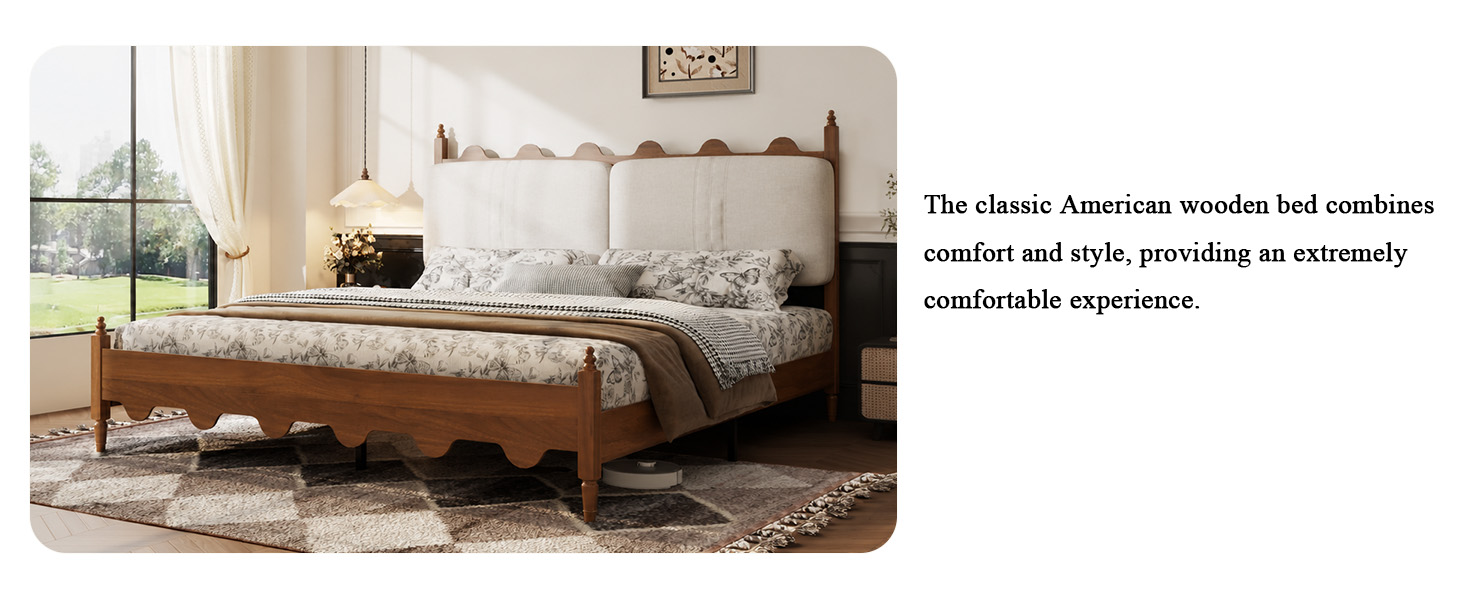

Quotable: One widely sold king headboard, the Modway Tranquil, is offered with seven mounting positions, and its retailer listing states that an adapter may be needed to attach it to an adjustable bed – a reminder that mounting height is a specification to confirm, not an assumption. (Source: retailer listing for the Modway Tranquil king headboard.)
Upholstered headboards with adjustable mounting height
Some panels are built specifically for this problem: the mounting plate has several height positions, so you can raise the panel after the base arrives instead of guessing beforehand. An example is the Huatean tufted king headboard with adjustable height, which uses a solid wood frame and multiple mounting positions. If your base is not yet delivered, a multi-position plate is the lower-risk purchase.
A buying checklist you can run in ten minutes
- Write down the base’s model number and look up whether the maker sells or supports headboard brackets. No bracket support means wall-mounted or a surrounding frame.
- Measure the mattress, not the old bed. Expect 76 by 80 inches for a king; a California king is longer and narrower, so a king panel will not line up.
- Measure your wall space and the panel height together. Add the mattress height to the panel’s visible height and check it against window sills, switches, and outlets.
- Confirm clearance through the full incline range. If the base lifts the head to 61 degrees, the panel needs roughly 10 to 14 inches of working gap, depending on the model.
- Check the hole pattern. Hole spacing, mounting-hole height, and bolt size must all match your bracket – “universal” is not a fitment guarantee.
- Decide split or solid before you buy. Two moving halves want either a wall-fixed panel or two separate sections.
If you are still choosing the bed underneath, our king bed frame buying guide covers dimensions and materials in more depth, and the mattress foundation versus box spring comparison explains why an adjustable base replaces a foundation rather than sitting on top of one.
Complete bed-and-headboard sets worth comparing
If you would rather buy the panel and the frame together than retrofit brackets, two configurations cover most king rooms. A metal frame with a fabric-covered headboard, such as the YITAHOME king bed frame with adjustable headboard, lists a 1,200 lb capacity for the bed frame and is the sturdier option for a heavy mattress. A platform bed with hardwood slats, such as the 1,000 lb-capacity model with a height-adjustable headboard that appears in retailer listings, is the lighter, easier-to-assemble route.
Our own adjustable bed base collection includes bases with head and foot incline plus remote control, and the king bed frame collection lists upholstered, rattan, metal, and platform options if you are pairing a fixed frame with a moving base. For softer, taller panels, the upholstered bed frame range is the place to start.
Where to compare king size headboard for adjustable bed side by side
These collections are grouped the way buyers actually narrow down this choice, so the specs you need are one click apart.
Frequently asked questions
Can you attach a headboard to an adjustable bed?
Yes, if the base has headboard brackets or the manufacturer sells an adapter kit. The bracket mounts to the base frame and the headboard bolts to it. If the base has no bracket support, a wall-mounted or freestanding headboard works without any modification to the base.
What size headboard fits a king adjustable bed?
A headboard at least 76 inches wide, matching the king mattress width, and commonly listed near 79.5 inches. Height is a separate decision: panels in the low 40s of inches sit comfortably above a mattress without crowding the sleeper when the head section is raised.
Will one king headboard work with a split king base?
It can, but a rigid panel bolted across two independently moving Twin XL bases ties them together and can work loose. A wall-mounted panel, a headboard on a surrounding frame, or two separate sections that move with their own half are the reliable options.
How much gap should there be between the headboard and the mattress?
One listed king bed specifies 10 to 14 inches between the headboard and the bedstead. Treat that as a starting range: the gap has to grow as the head section rises, because the mattress moves away from a fixed panel through the incline arc.
Do universal headboard brackets fit any headboard?
No. Universal usually describes a range of hole spacings, not a guaranteed match. Compare the bracket’s hole spacing, mounting height, and bolt size with your headboard’s mounting plate, and check the bracket is rated for the panel’s weight.
The short version
Width is settled at 76 inches and up. What you are really deciding is how the panel meets the moving base: brackets on the base, a frame around the base, or a panel fixed to the wall. Confirm your base supports brackets before you buy, measure the mounting holes rather than trusting the word universal, and leave 10 to 14 inches of working gap so the head section can reach its full incline without hitting the panel. Get those three things right and the rest is finish, fabric, and price.